





Hospital software isn’t ready for AI if it lacks standards-based APIs, trustworthy data, auditable access controls, hooks for AI oversight, and a way to change workflows without waiting on a vendor. About 71% of U.S. hospitals already use EHR-integrated predictive AI, so these gaps decide who can scale it safely.
AI is no longer a future possibility for hospitals. It is already part of everyday operations. Federal survey data show 71% of U.S. hospitals used predictive AI inside their EHR in 2024, and a Guidehouse–HIMSS survey found 78% of health systems running AI projects. Yet only 52% said they were operationally ready to put AI into practice. Because the survey included roughly 50 leaders, its findings are best viewed as an indication of the challenges rather than a definitive industry benchmark.
The challenge often lies less with the AI model than with the systems supporting it. Data may be difficult to access, records may be inconsistent, access histories may be incomplete, and even minor workflow updates may take months. Here are five warning signs to look for, why they matter, and what hospitals can do next.
Key Takeaways
- AI readiness depends on accessible, reliable data; traceable access; practical oversight; and the ability to improve workflows without lengthy delays.
- Federal data show a readiness divide: 86% of system-affiliated hospitals use predictive AI versus 37% of independent ones.
- Documented APIs, including FHIR-based interfaces, are an important foundation. Certain payer API requirements take effect on January 1, 2027.
- An AI governance committee needs technical support, including audit logs, model inventories, and human review processes.
- Replacing an entire system is not always necessary. Start by modernizing the component that creates the biggest obstacle.
What “AI-Ready” Means for a Hospital
Hospital software is ready for AI when approved tools can securely access governed data, return useful information to existing clinical workflows, and create a clear audit trail while protecting patient information. Readiness does not mean introducing AI into every process. It means having the safeguards and flexibility to adopt it when there is a genuine need.
5 Signs Your Hospital Software Isn’t Ready for AI
Sign 1: AI pilots run on file exports, not APIs
When each AI pilot begins with a manual CSV export, it is a sign that data access needs attention. AI applications work best with timely, structured information and a reliable way to return results to the systems staff already use. Manual exports and disconnected interfaces make that difficult to sustain.
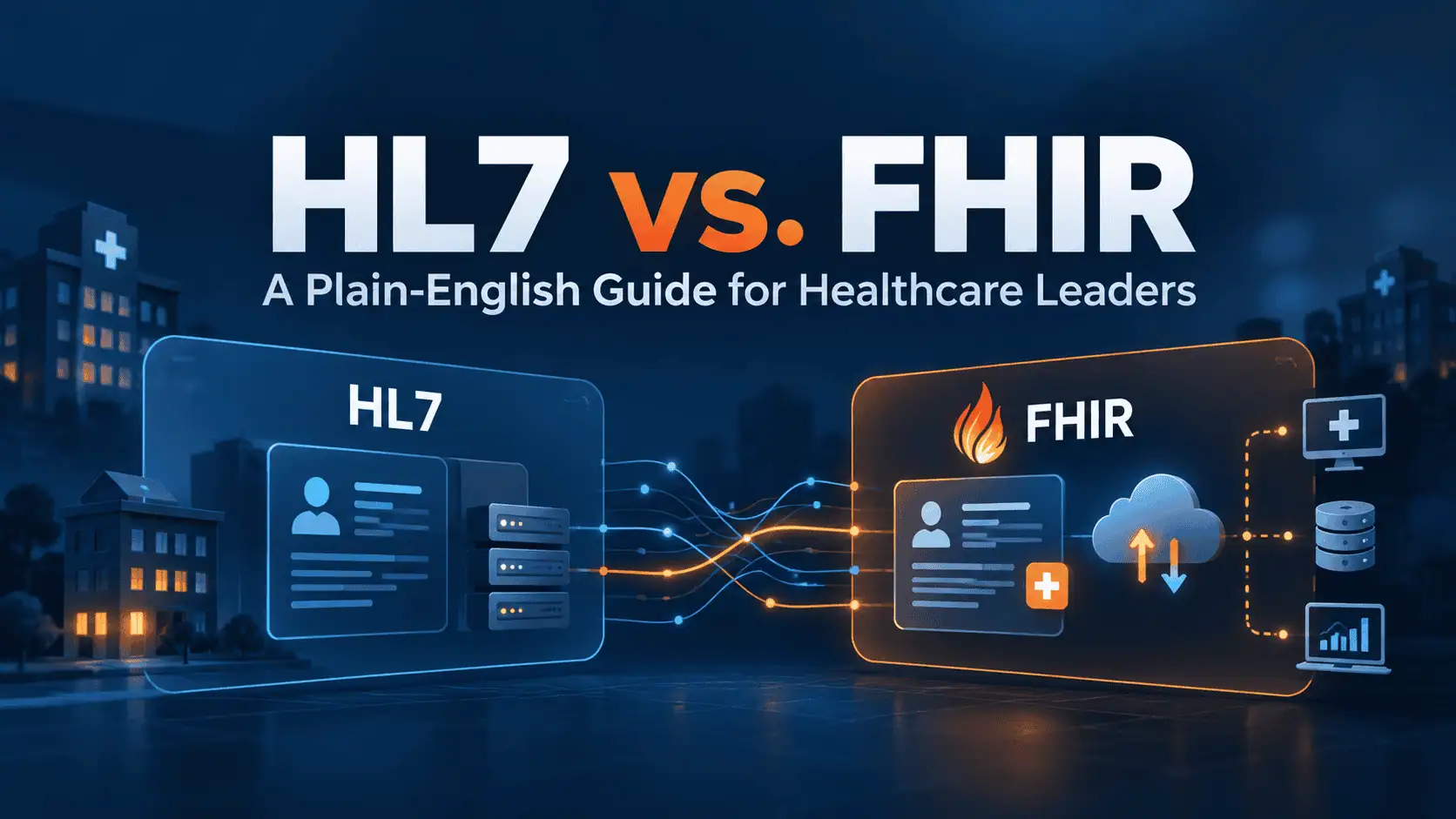
There are established standards to help. FHIR lets applications request and write specific data over a documented, secure interface, and ChampSoft’s HL7 vs. FHIR primer explains how it differs from older HL7 messaging. Regulatory expectations are also evolving. Under CMS’s interoperability rule, impacted payers must run Patient Access, Provider Access, Payer-to-Payer, and Prior Authorization APIs by January 1, 2027, and eligible hospitals begin reporting an electronic prior authorization measure in the 2027 EHR reporting period.
Quick test: Can your team name which systems expose a current, documented FHIR or REST API, and which do not?
Sign 2: Nobody fully trusts the data underneath
AI cannot compensate for unreliable source data. Duplicate patient records, inconsistent coding, and missing information about data origins can lead to misleading outputs. In the Guidehouse HIMSS survey, 42% of leaders worried about data quality, standardization, availability, or governance.
Watch for departments reporting different numbers for the same measure, manual patient-matching cleanup, and fields nobody can trace to a source. The practical response is to strengthen patient matching, standardize codes, validate incoming data, and document where information comes from. In its Health Cost IQ case study, ChampSoft automated ingestion across more than 20 vendor file formats and strengthened monitoring on a healthcare analytics platform.
Sign 3: Your system can’t show who accessed what
AI makes access control even more important. A model or agent reading records on a clinician’s behalf should see only the minimum necessary data, and every request should be traceable. Shared service accounts, coarse role permissions, and logs that live only in a vendor console can’t deliver that.
Warning signs include audit reports that need a vendor ticket, integrations sharing one login, and no way to separate a person’s access from an automated tool’s. ChampSoft’s guide to AI agents and PHI walks through nine controls for securing them.
Sign 4: Your software can’t support AI oversight
AI governance is not only about policies and committees. Teams also need systems that record enough information to review how AI tools are being used. The federal data brief shows most hospitals evaluate predictive models, but independent hospitals evaluated accuracy at 41% versus 76% for system members. In Wolters Kluwer Health’s December 2025 survey of 518 hospital staff, 17% admitted using unapproved AI tools.
The Joint Commission and CHAI guidance names seven elements, including governance structures, ongoing monitoring, bias assessment, and safety-event reporting. To meet them, software needs a model inventory, logging of every AI output with its data and version, capture of clinician overrides, and drift monitoring. Without these capabilities, it becomes difficult to turn governance policies into day-to-day practice.
Sign 5: Every change waits in a vendor queue
AI initiatives often move faster than traditional software release schedules. The federal brief found 80% of hospitals draw predictive AI from their EHR developer, and use differs sharply by vendor: 90% on the market leader versus 50% elsewhere. Depending on an EHR vendor is not necessarily a problem, but it can limit flexibility. In a Qventus survey of 60+ health system technology leaders, 74% cited EHR dependency as a top execution barrier, and willingness to wait for an EHR feature fell from 52% to 22%.
Signs include AI results appearing in a separate window, simple workflow changes taking quarters, and bespoke interface work for every integration. One option is to introduce modular capabilities around the existing system, improving workflows in manageable stages instead of replacing the platform all at once.
Quick Readiness Self-Check
| Area | Not ready if… | AI-ready looks like… | Ask your team |
| Data access | Pilots run on CSV exports | Documented FHIR/REST APIs | Which systems expose a current API? |
| Data quality | Duplicates, unclear lineage | Governed, validated, traceable data | Who owns each key data set? |
| Security | Shared accounts, vendor-only logs | Least-privilege access, full audit trail | Can we produce an access report today? |
| Oversight | No record of AI outputs | Model inventory, logging, drift monitoring | Which AI tools run, and who reviews them? |
| Change | Quarter-long vendor queues | Modular, incremental releases | How long does a workflow change take? |
Where to Start
Begin with a focused use case. Federal data show billing and scheduling were the fastest-growing predictive AI uses, which makes them sensible first targets.
- Inventory your systems and which ones expose usable APIs.
- Pick one administrative use case with a clear owner.
- Fix the identity, data quality, and audit gaps that use case touches.
- Add logging and monitoring before you scale.
For the cost side of waiting, see what outdated healthcare software really costs.
How ChampSoft Helps Hospitals Become AI-Ready
ChampSoft has built healthcare software since 2010 and treats AI as an engineering and governance problem. Its healthcare practice covers:
- Interoperability: HL7, FHIR, and SMART on FHIR integration through its system integration practice.
- Data engineering: pipelines, validation, and lineage that give models data worth trusting.
- Governed AI: private model hosting, controlled inference layers, and human review.
- Credentials: HIPAA, SOC 2 Type II, ISO 9001, and ISO/IEC 42001, listed on its compliance page.
- Track record: 300+ healthcare engagements and 50+ AI systems in production (company-reported); clients own their code and IP.
Talk to ChampSoft’s healthcare engineering team about where your software stands and what to fix first.
The Bottom Line
A hospital may have access to powerful AI tools and still struggle to use them effectively. The obstacles are often familiar: disconnected systems, inconsistent data, limited auditability, weak oversight, and slow software changes. Identify the issue holding your organization back, address it first, and build toward AI adoption that is practical, secure, and sustainable.
FAQs
What does AI-ready mean for hospital software?
It means models can securely read governed clinical and operational data, write results back into clinician workflows, and leave a complete audit trail. Standards-based APIs, data quality controls, access logging, and human review are the building blocks.
How can I tell if my EHR is ready for AI?
Check four things: whether it exposes documented FHIR or REST APIs, whether you can export audit and access reports without a vendor ticket, how clean your patient identity and code data are, and how long a workflow change takes.
Do we have to replace our EHR to adopt AI?
Usually not. Many hospitals add an integration and data layer around the core system, fix the highest-friction modules first, and keep production workflows running. Replacement is justified only when the core platform can’t be secured or opened up.
Is FHIR required for hospital AI?
Not strictly, but it is the most practical standard for moving data between applications. Payer FHIR API deadlines fall on January 1, 2027, so hospitals without FHIR capability will increasingly rely on manual workarounds.
What is the primary challenge preventing hospitals from adopting AI?
Surveys point to data quality and integration more than the models themselves. In a Guidehouse–HIMSS survey, 42% of leaders worried about data quality, standardization, availability, or governance, and a separate survey ranked EHR dependency as a top execution barrier.
How should hospitals govern AI safely?
Start with the Joint Commission and CHAI guidance: formal governance, ongoing monitoring, bias assessment, and staff training. Then make sure your software can log AI outputs, capture clinician overrides, and show which model version produced each result.