





If your technology leaders keep saying “HL7” and “FHIR” in the same breath, you are not alone in wondering which one deserves your budget. The honest answer is that it is rarely an either-or choice. HL7 v2 quietly runs the data feeds that keep hospitals operating today. Federal regulations, payers, and patient applications are increasingly adopting FHIR.
This guide explains both in plain English, shows where they differ, lays out the U.S. regulatory dates that matter, and gives you six questions to ask before your next interoperability investment. It is written for executives at large health systems, payers, and provider networks who need to make decisions, not write code.
Key Takeaways
- HL7 v2 and FHIR serve distinct purposes in healthcare data exchange. HL7 v2 pushes event messages between systems; FHIR serves specific data to apps and partners through web APIs.
- HL7 v2 is deeply embedded. HL7 reports that over 95% of U.S. healthcare organizations use it.
- FHIR is where regulation is heading. Certified health IT must offer FHIR APIs, and many payer API deadlines arrive on January 1, 2027.
- Replacing every HL7 v2 interface with FHIR is rarely worth the cost or risk. A hybrid approach, with an integration layer between the two, is the practical path.
- Your biggest risks are rarely the standards themselves. The key challenges include poorly documented system interfaces, unreliable data consistency, and undefined responsibilities.
What Is HL7?
HL7 stands for Health Level Seven, a nonprofit standards organization whose name also refers to the family of standards it publishes. When people say “HL7” inside a hospital, they almost always mean HL7 version 2, the messaging standard first released in October 1987.
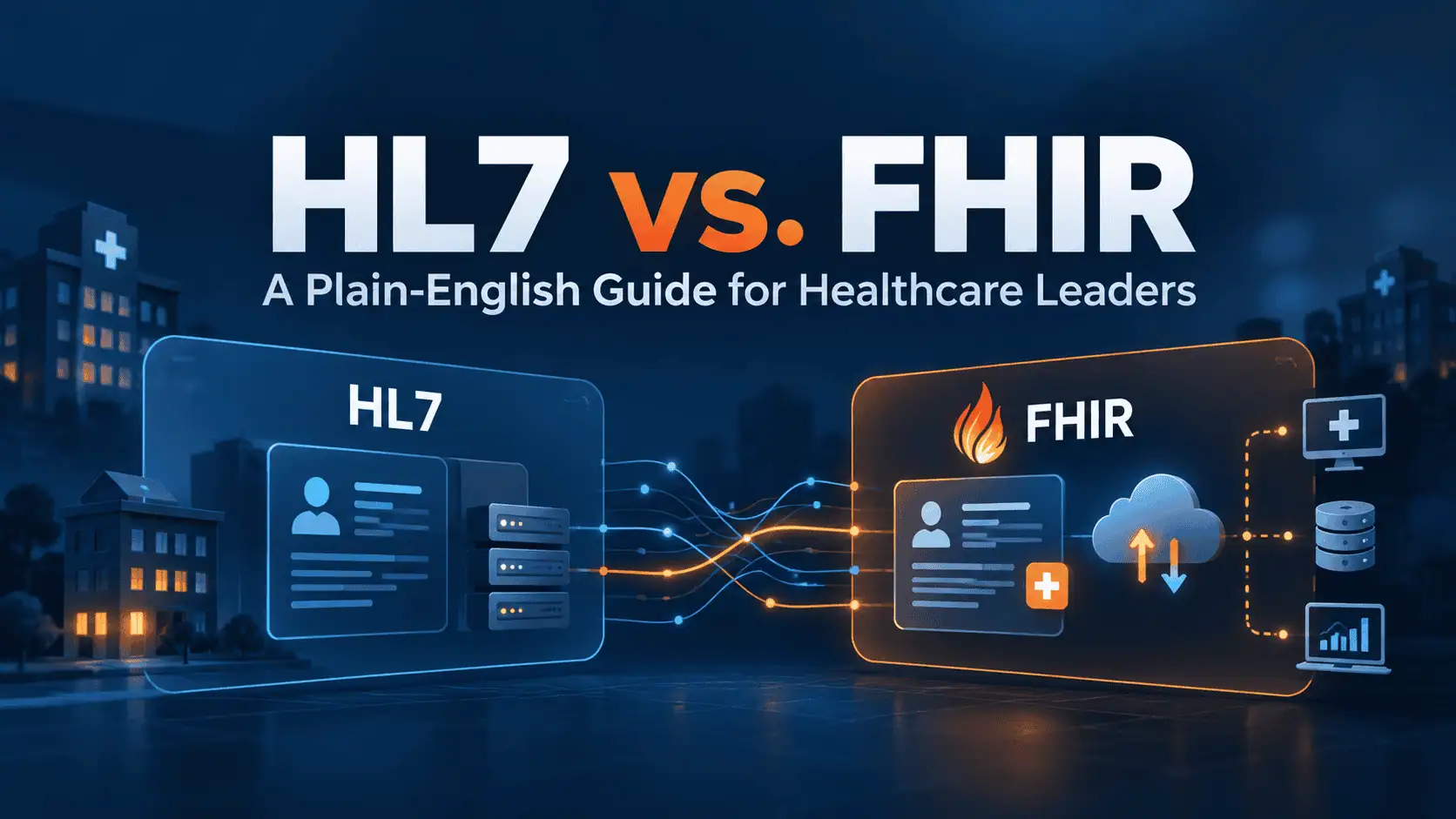
Think of HL7 v2 as a standing delivery route. When something happens, such as a patient admission, a finalized lab result, or a new order, the sending system packages a short, pipe-delimited message and pushes it to every system subscribed to that event. Registration, laboratory, radiology, pharmacy, and billing systems have exchanged data this way for decades.
Its reach is remarkable. HL7’s own product brief states that HL7 v2 remains widely adopted across healthcare systems, with a 2023 ASTP/ONC survey reporting that 96% of health information exchanges receive admission, discharge, and transfer (ADT) messages in this format.
The catch is flexibility. HL7 v2 allows organizations to customize fields, so two hospitals can send the “same” message in subtly different ways. That is why interface engines and skilled analysts sit between most systems.
What Is FHIR?
Fast Healthcare Interoperability Resources (FHIR), commonly pronounced “fire,” is a standard designed to support healthcare information exchange. HL7 International developed it to borrow what works on the modern web. Data is organized into small, consistent building blocks called resources, such as Patient, Observation, Medication, and Encounter. Apps retrieve them through standard web APIs, using familiar formats like JSON and security methods like OAuth.
If HL7 v2 is a delivery route, FHIR is a well-organized website. An app does not wait for a message. It asks for exactly what it needs, such as a patient’s recent medications, and gets a structured answer. That makes FHIR far easier for app developers, payers, and digital health partners to work with, including teams with no hospital-interface background.
FHIR also supports the exchange of data elements defined by USCDI, the national baseline list of data elements. In plain terms, USCDI defines what data should be shareable, and FHIR, through the US Core implementation guide, defines how to share it.
HL7 v2 vs. FHIR: The Key Differences
| Factor | HL7 v2 | FHIR |
| First released | 1987 | Early 2010s |
| How data moves | Event-driven messages pushed between systems | On-demand requests through web APIs |
| Data format | Pipe-delimited text segments | JSON or XML resources |
| Best suited to | Admissions, lab, orders, internal departmental feeds | Apps, patient access, payer exchange, analytics |
| Consistency | High flexibility; local variations are common | Consistent when profiles such as US Core are used |
| Skills required | Specialized interface analysts | Web and API developers, a broader talent pool |
| Regulatory role | No federal rule requires retiring it | Named in federal certification and payer API rules |
| Typical risk | Undocumented, hard-to-change interfaces | Version drift and incomplete data mapping |
Why Leaders Should Care Now: The U.S. Regulatory Picture
Certified health IT already runs on FHIR
The 21st Century Cures Act rules made FHIR Release 4 the foundation for certified EHR APIs. Effective January 1, 2026, the HTI-1 rule established USCDI Version 3 as the minimum required standard for applicable certified health IT systems. The result is visible in hospital data: in 2024, 70% of hospitals enabled patient access through applications that conform to FHIR specifications, according to an ASTP data brief.
Payers and prior authorization
CMS-0057-F requires Medicare Advantage, Medicaid and CHIP, and certain Affordable Care Act plans to build FHIR-based Patient Access, Provider Access, Payer-to-Payer, and Prior Authorization APIs. The CMS fact sheet indicates that most applicable compliance requirements take effect starting January 1, 2027. CMS also will not enforce the X12 278 standard under HIPAA for payers that use an all-FHIR prior authorization API. For provider leaders, that means revenue cycle and utilization teams will increasingly work with payers through FHIR endpoints.
What is still moving
In December 2025, HHS proposed HTI-5, which would remove 34 of the 60 certification criteria and reset the program around FHIR-based APIs. If approved in its current form, the proposal would further strengthen the shift toward FHIR-based interoperability. Meanwhile, TEFCA’s FHIR roadmap is introducing facilitated FHIR exchange between national networks.
Will FHIR Replace HL7 v2?
Not anytime soon, and for most organizations, not entirely. The adoption data shows why. FHIR is mainstream for patient access, but an ASTP/ONC presentation drawing on the 2024 AHA survey noted that most hospitals share clinical and administrative data with third-party technology, but mostly through non-standards-based approaches.
Meanwhile, existing HL7 v2-based ADT feeds, laboratory interfaces, and order workflows remain functional, represent established investments, and are deeply integrated into clinical operations. Replacing them adds risk with little clinical payoff. The more useful question is which data flows should be exposed through FHIR in addition to HL7 v2.
Three Common Misconceptions
- “FHIR is just a new version of HL7 v2.”It is not. Developed by HL7 International, FHIR uses a distinct data structure and a web-based API approach to support healthcare information exchange. The two are not interchangeable, and moving between them requires translation.
- Having a FHIR API does not automatically enable interoperability, as it only makes the underlying data accessible. If that data is inconsistent, duplicated, or poorly coded, partners will receive inconsistent data, only faster.
- HL7 v2 remains a well-established and widely used standard rather than an outdated technology. For event-driven, high-volume internal feeds, it remains a proven and well-understood fit.
Where Each Standard Fits
Keep HL7 v2 for
- Admission, discharge, and transfer feeds
- Laboratory, radiology, and pharmacy orders and results
- High-volume internal departmental interfaces
Use FHIR for
- Patient-facing apps and portals
- Payer connectivity, including prior authorization
- Population health, quality reporting, and analytics
- New digital products, partner ecosystems, and AI-ready data access
The Practical Path: Run Both, Connect Them, Modernize Selectively
Three Practical Steps for Healthcare Enterprises to Modernize Their Systems.
- Put an integration layer in the middle: An interface engine such as Mirth Connect can receive HL7 v2 messages, translate them, and expose them as FHIR resources, so downstream apps never need to understand legacy feeds. ChampSoft has written about how Mirth Connect supports HL7 healthcare integration.
- Modernize by use case, not interface count: Prioritize data flows associated with regulatory deadlines or revenue objectives, such as payer APIs or patient access, rather than converting everything.
- Treat mapping as a data-quality project: HL7 v2 to FHIR conversion is not a straight copy. Local codes, optional fields, and inconsistent patient identifiers must be reconciled, or the new API will simply expose old inconsistencies faster.
Six Questions to Ask Before Your Next Interoperability Investment
- Which of our data flows are tied to a regulatory deadline, and which are optional?
- Do we have a complete, current inventory of HL7 v2 interfaces, including owners and documentation?
- Which FHIR version and implementation guides, such as US Core, do our vendors support today and plan to support next?
- How will we govern API access, including consent, authorization scopes, and audit trails for protected health information?
- Who is accountable for mapping and data quality between our HL7 v2 feeds and FHIR resources?
- Do we have the necessary in-house expertise or an external partner to support both standards over the next five years?
How ChampSoft Helps Healthcare Organizations Navigate HL7 and FHIR
ChampSoft has built software since 2010, and its healthcare practice lists 300+ healthcare projects. Its integration work spans:
• Custom HL7 interface engines
• FHIR integration and SMART on FHIR development
• Health information exchange frameworks using HL7 and FHIR
• Master data management across patients, providers, and medications
That work is backed by HIPAA compliance and SOC 2 Type II, ISO 9001, and ISO/IEC 42001 certification.
A relevant example: ChampSoft built a bi-directional HL7 interface with Mirth Connect for CareHere, now part of Premise Health. Its legacy EHR could not handle electronic lab interfacing, so lab orders and results ran through manual, error-prone processes. ChampSoft retrofitted the system without replacing it, rolled it out to 165+ clinical sites in six months under budget, and now supports over 4 million HL7 transactions annually with a post-implementation error rate below 1%. For organizations facing similar constraints, ChampSoft’s system integration services follow the same pattern: connect what exists, modernize what matters.
Planning your HL7 and FHIR roadmap? Talk to a ChampSoft healthcare integration expert.
The Bottom Line
HL7 v2 and FHIR are best understood as two tools for two jobs. HL7 v2 keeps your internal data moving. FHIR opens that data to apps, payers, and patients under rules that increasingly name it. The winning strategy is not a rip-and-replace program. It is an inventory, a translation layer, and a prioritized roadmap tied to regulatory dates and business value. Begin by documenting existing interfaces, as an effective modernization roadmap depends on understanding the systems already in place. Then pick one regulatory-driven use case, prove the pattern, and scale from there.
FAQs
What does HL7 stand for?
HL7 stands for Health Level Seven. It is both a standards organization, HL7 International, and the name of its family of healthcare data standards. In day-to-day hospital use, “HL7” usually means HL7 version 2 messaging, while FHIR is HL7 International’s newer standard.
Is FHIR replacing HL7?
Not entirely. FHIR is where new development and federal API requirements are focused, but HL7 v2 remains embedded in most U.S. healthcare organizations. Most health systems will run both for years, using an integration layer to translate between them.
How do HL7 v2 and FHIR differ in their approach to healthcare data exchange?
HL7 v2 sends event-driven messages between systems, such as an admission notice or a lab result. FHIR exposes data as structured resources that apps request on demand through web APIs. HL7 v2 suits system-to-system feeds; FHIR suits apps, partners, and patients.
Is FHIR required in the United States?
Federal rules require FHIR-based APIs for specific purposes. ONC-certified health IT must support a standardized FHIR API, and CMS requires certain payers to implement FHIR-based APIs, with compliance dates generally beginning January 1, 2027. Federal rules do not require retiring existing HL7 v2 interfaces.
What is an HL7 interface engine, and do we still need one?
An interface engine receives, transforms, and routes messages between systems that speak different formats. Even as FHIR grows, engines remain useful because they translate legacy HL7 v2 feeds into FHIR resources and handle routing, monitoring, and error handling across both standards.
How do USCDI and FHIR relate?
USCDI is the national list of health data elements that should be available for exchange. FHIR is the technical standard used to share them, with the US Core implementation guide specifying how USCDI data appears in FHIR. USCDI version 3 became the certification baseline on January 1, 2026.