
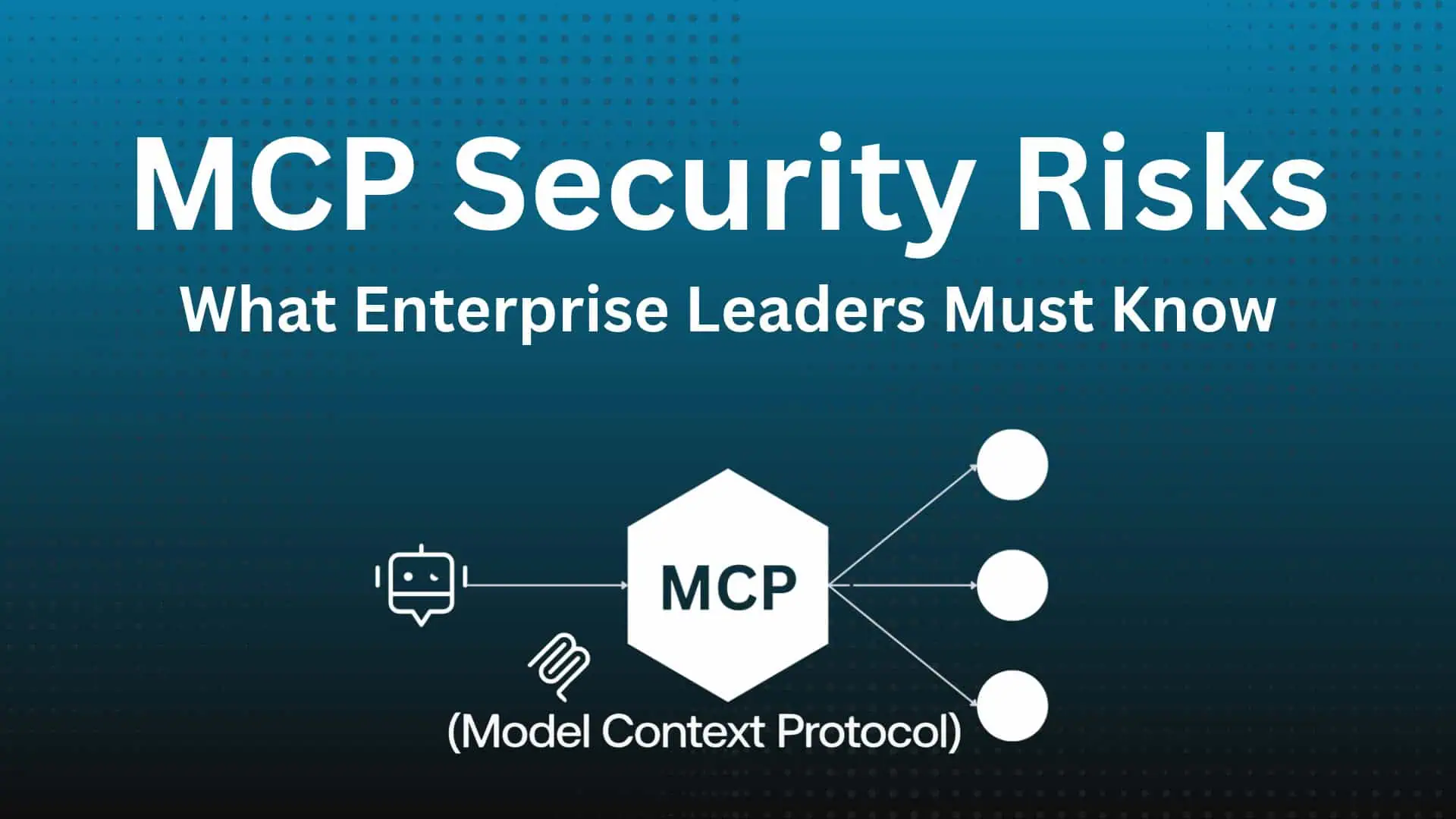





MCP security risks are the vulnerabilities created when AI agents connect to business systems through the Model Context Protocol. The biggest are prompt injection, tool poisoning, excessive permissions, leaked tokens, supply chain compromise, and unmonitored servers. Enterprises reduce them with least-privilege access, an approved server inventory, full audit logging, and human approval for high-impact actions.
A productivity tool is an AI agent with the ability to read a client record. An AI agent that can read a customer record, open an email from a stranger, and send a message outside the company is an incident waiting to happen. The Model Context Protocol (MCP) is the standard that makes both possible, which is why MCP security has moved from developer forums to board agendas.
In May 2026, the U.S. National Security Agency published its first formal guidance on MCP, warning that adoption has run ahead of the protocol’s security model. Gartner expects the problem to grow before it shrinks. This guide explains the main MCP security risks in leadership terms, shows the real incidents behind them, and gives you an MCP security checklist you can use as a gate before any server reaches production. If you need the basics first, read our explainer on how MCP lets AI agents reach legacy systems.
Key Takeaways
- The risk is in how agents trust content, not only in code. Hidden instructions in a tool description, a document, or a support ticket can steer an agent into harmful actions.
- Security has to cover the whole environment. The NSA says MCP’s risks cannot be patched at isolated endpoints.
- Some use cases should not ship. Gartner advises treating any flow that combines sensitive data, untrusted content, and external communication as a no-go zone.
- A live attack surface is the supply chain. A counterfeit email server, a critical flaw in a package downloaded more than 437,000 times, and agent-hijacking prompt injections have all been documented.
- Five controls do most of the work: least-privilege identity, an approved server inventory, untrusted-input handling, full audit logging, and human approval for high-impact actions.
What Is MCP Security?
MCP security is the set of controls that protect AI agents, MCP servers, and the business systems behind them from misuse, data leakage, and attack. It answers four questions: who the agent acts as, which tools it may call, what content it is allowed to trust, and what evidence remains afterwards.
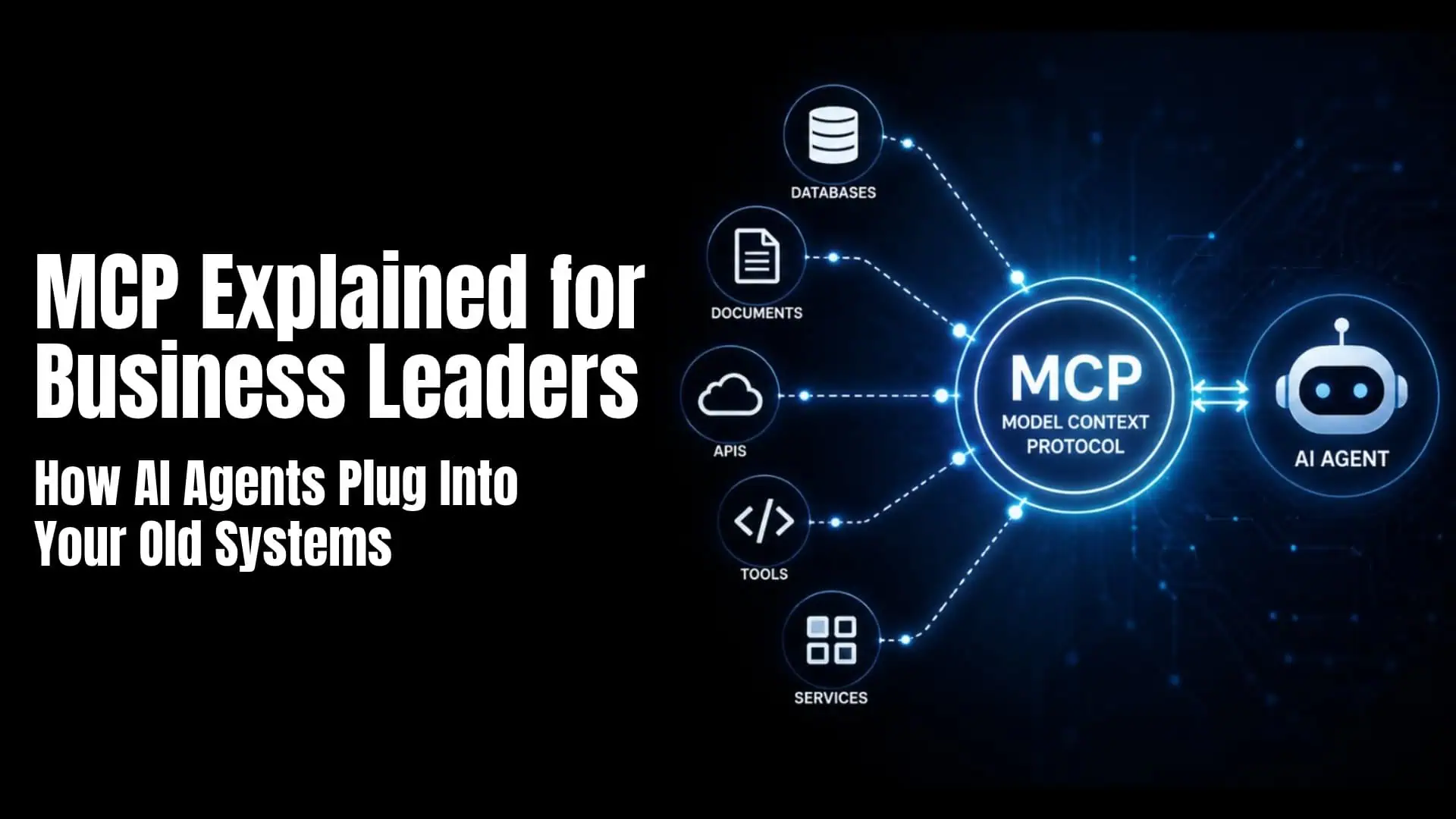
The Model Context Protocol, introduced by Anthropic in November 2024, is an open standard that lets AI applications discover and call external tools and data. The service that gives the agent access to a system’s capabilities is called an MCP server. MCP server security is therefore the discipline of hardening that service and the connection around it.
How MCP security differs from API security
Traditional API security assumes a predictable caller. MCP puts a language model in the caller’s seat, and a model can be persuaded. That changes where the trust boundary sits.
| Caller | Fixed code written by a developer | A model that decides at runtime which tool to call |
| What counts as input | A request payload checked against a schema | Tool descriptions, retrieved documents, and tool outputs all become model input |
| Failure mode | A bug or a misconfiguration | A bug, a misconfiguration, or a successful attempt to persuade the agent |
| Permissions | Scoped to the application | Often inherited from a person or a broad service account |
| Audit question | Which request hit this endpoint? | What did the agent decide, why, and on whose behalf? |
| Change control | A versioned release | Tool definitions can change after approval |
Why MCP Security Is a Leadership Issue in 2026
MCP has been recorded by the NSA. Its Artificial Intelligence Security Centre published a Cybersecurity Information Sheet on May 20, 2026, that highlights serialisation risks, trust boundaries, and agent misuse. The agency notes that dynamic tool invocation and implicit trust relationships create systemic risk, and that these issues must be addressed across the entire MCP environment rather than patched one endpoint at a time.
Analysts expect incidents to rise. Gartner projects that by 2028, 25% of enterprise generative AI applications will experience at least five minor security incidents a year, up from 9% in 2025. By 2029, it expects 15% to suffer at least one major incident a year, up from 3% in 2025. Gartner’s reasoning is that MCP was designed for interoperability and ease of use first, so mistakes can surface through ordinary usage.
The vulnerability count is climbing. Public CVE filings against MCP servers, clients, and tooling passed 30 in the first two months of 2026 alone. The sections below show what those flaws look like in practice.
The 7 MCP Security Risks Enterprise Leaders Must Know
These map closely to the OWASP MCP Top 10, which is still in beta and evolving. Each risk includes a question you can put to your engineering or security team this week.
1. Prompt injection through tool results and documents
An agent reads content as part of its job. The agent might obey any concealed instructions in such text. In May 2025, researchers showed that a malicious public GitHub issue could redirect an agent connected to the GitHub MCP server into reading private repositories and publishing their contents. No code flaw was needed. The agent simply obeyed instructions it found in data.
Ask: Which content can this agent read that we do not control?
2. Tool poisoning and rug pulls
The model reads tool descriptions as trusted context, so an attacker can hide instructions in them. A related “rug pull” changes a tool’s definition after someone has approved it. OWASP lists tool poisoning as MCP03, and a 2025 flaw in a popular AI code editor (CVE-2025-54136) showed the danger: an approved MCP configuration was not re-validated after the first approval.
Ask: What happens when a tool we approved changes its description?
3. Excessive permissions, scope creep, and confused deputy
An MCP server that acts with its own broad privileges, rather than the requesting user’s, becomes a confused deputy. A low-privilege person, or a manipulated agent, can reach data and actions they should not. The MCP specification’s security guidance forbids token passthrough and requires per-client consent for proxy servers. OWASP tracks the same family of problems as scope creep (MCP02) and insufficient authentication and authorisation (MCP07).
Ask: Whose identity does the agent act under, and with what permissions?
4. Token mismanagement and secret exposure
Hard-coded credentials, long-lived tokens, and secrets that end up in model memory or logs can be extracted through prompt injection or debug traces. OWASP ranks this first (MCP01) because one leaked token can give an attacker the same reach as the agent.
Ask: Are our agent tokens short-lived, narrowly scoped, and kept out of logs?
5. Supply chain: malicious and vulnerable MCP packages
MCP servers are often installed like any other package, with a one-line configuration change and little code review. In September 2025, Koi Security disclosed postmark-mcp, a counterfeit email server that quietly copied outgoing mail to an attacker. It was pulling roughly 1,500 downloads a week and was estimated to be in use at about 300 organizations. Separately, CVE-2025-6514 (CVSS 9.6) in the mcp-remote package let a malicious server run commands on a developer’s machine during connection, affecting more than 437,000 downloads.
Ask: Which MCP servers are approved, and who verifies where they come from?
6. Command injection and unsafe local servers
Many MCP servers are thin wrappers around command-line tools, and building shell commands from untrusted input is the classic mistake. Even reference implementations are not immune: three chained flaws in the official Git MCP server (CVE-2025-68143, -68144, and -68145) were disclosed in January 2026, and the MCP Inspector debugging There was a remote code execution vulnerability in ool itself (CVE-2025-49596). OWASP lists command injection as MCP05.
Ask: Have we reviewed the code of every server that touches a shell, a file system, or a database?
7. Shadow MCP servers and missing audit trails
Developers spin up MCP servers to experiment, sometimes with default credentials and permissive settings. OWASP calls these shadow MCP servers (MCP09) and flags missing telemetry as a separate risk (MCP08). Without logs of tool calls, security teams cannot investigate, and compliance teams cannot show what an agent did.
Ask: Can we list every MCP server in use today, and show what each one did last week?
Risk-to-control summary
| Prompt injection | Hidden instructions in an issue, email, or document | Data leaves the company; wrong actions taken | Treat all retrieved content as untrusted; limit external actions |
| Tool poisoning | Malicious text in a tool description or a changed definition | Agent steered without any code exploit | Review and pin tool definitions; re-approve on change |
| Excess permissions | Agent runs on a broad service account | Low-privilege users reach sensitive data | Per-agent identity; read-only first; scoped tokens |
| Token exposure | Long-lived keys in config, memory, or logs | Full compromise of connected systems | Short-lived, audience-bound tokens in a vault |
| Supply chain | Counterfeit or vulnerable MCP package | Silent data theft; remote code execution | Approved sources, version pinning, code review |
| Command injection | Server builds shell commands from input | Remote code execution on a host | Parameterized calls; sandbox; allowlists |
| Shadow servers | Unapproved servers with default settings | Unmonitored access paths; failed audits | Discovery scans; central registry; audit logging |
A Simple Decision Rule: Gartner’s MCP No-Go Zone
Gartner’s guidance gives leaders a rule that does not require reading code. Three conditions raise exfiltration risk sharply when they appear in the same flow:
- The agent can access sensitive data, such as personal or financial records.
- The agent ingests untrusted content, such as inbound email, web pages, or user-submitted tickets.
- The agent can communicate externally, such as sending messages or calling outside services.
Gartner advises treating any use case that combines all three as a no-go zone. The practical fix is to break the flow by removing one leg. For example, a support assistant that reads inbound customer email (untrusted) and looks up account details (sensitive) should not also be able to send email to external addresses without a human approving it. This example is illustrative, not drawn from a specific incident.
MCP Security Best Practices
These eight practices turn the risks above into engineering work. They also match the direction of the NSA, OWASP, and MCP specification guidance.
- Inventory every server and client. Run discovery to find shadow servers, and keep one registry of approved ones.
- Give each agent its own identity. Apply least privilege, start read-only, and add write actions only with approval gates.
- Validate tokens properly. Accept only tokens issued for your server, never forward them downstream, and prefer short-lived credentials.
- Handle retrieved material, tool outputs, and tool descriptions as untrusted input. Validate and sanitize, and never execute commands derived from context.
- Control the supply chain. Install from approved sources, pin versions, review code before adoption, and re-review when definitions change.
- Isolate runtime. Run servers in containers with restricted file system access and network egress, and avoid building shell commands from strings.
- Log every tool call. Record who, which agent, which tool, what parameters, and what result, in immutable storage with alerting.
- Require human approval for high-impact actions, and test rollback before go-live.
MCP Security Checklist for Enterprise Teams
Use this as a pre-production gate. Each row names the evidence your team should be able to produce. If a row has no evidence, the control does not exist yet.
| Inventory | Do we know every MCP server and client in use? | Central registry; discovery scan results |
| Identity | Does each agent act under its own identity? | IAM roles and policy definitions |
| Authorization | Is every tool scoped to the minimum, read-only by default? | Tool permission matrix |
| Tokens | Are tokens short-lived, audience-bound, and vaulted? | Token policy; secret-scan reports |
| Input trust | Are descriptions, outputs, and retrieved content handled as untrusted? | Injection test cases and results |
| Supply chain | Are servers from approved sources, pinned, and reviewed? | Approved list; dependency scan reports |
| Isolation | Are servers sandboxed with restricted network egress? | Architecture diagram; runtime configuration |
| Data flow | Does any flow combine sensitive data, untrusted content, and external communication? | Use-case review record |
| Audit | Is every tool call logged in tamper-resistant storage? | Sample logs; retention policy |
| Human oversight | Do high-impact actions need approval, with rollback? | Approval records; rollback runbook |
| Incident response | Can we revoke an agent’s access within minutes? | Tested response playbook |
| Change control | Do tool definition changes trigger re-review? | Change log; re-approval records |
Secure MCP Implementation: Build, Buy, or Partner?
Most enterprises end up doing all three: consuming vendor-provided servers, adopting open-source ones, and building internal servers that wrap their own systems. The internal ones carry the most risk, because the code, the permissions, and the failure modes are yours.
If a system has no usable interface, safe wrapping is a modernization question before it is an AI question. Our guide to connecting systems that have no APIs covers the options.
What to demand from MCP server development services
Whether you hire a partner or staff it internally, a secure MCP server build should include:
- A threat model before code, covering each tool, the data it touches, and the trust boundaries.
- A written specification for every tool: purpose, permissions, inputs, outputs, and failure behavior.
- Authorisation and authentication in accordance with OAuth security guidelines and the MCP specification.
- Static and dynamic security testing and dependency scanning inside the CI/CD pipeline.
- Logging, monitoring, and alerting designed in, not added later.
- Full ownership of code and documentation at handover, with no lock-in.
How ChampSoft Approaches Secure MCP Implementation
ChampSoft is a global software engineering and AI development partner that has built secure, enterprise-grade systems since 2010. Its delivery model is a spec-first, AI-augmented SDLC with mandatory human oversight, and the company holds HIPAA compliance, SOC 2 Type II, ISO 9001, and ISO/IEC 42001 certifications (see its accreditation and compliance details).
ChampSoft’s Secure SDLC already contains the practices an MCP build needs. Here is how they map:
- Threat modelling and secure design reviews apply to tool design, permission scopes, and trust boundaries.
- Least-privilege access controls and encrypted data handling apply to agent identity and token management.
- Static and dynamic analysis, vulnerability scanning, and CI/CD quality gates apply to server code and its dependencies.
- Human oversight, documentation, and traceability apply to approval gates and audit evidence.
- Full client ownership of code and IP means no lock-in on the servers you commission.
For teams that need an independent view before building, ChampSoft’s architecture and AI-readiness consulting can scope a pilot, and its Data & AI practice covers the governed data layer agents rely on.
The Bottom Line
MCP does not make agents unsafe by default, and it does not make them safe either. Security depends on the permissions you grant, the content you let agents trust, the servers you allow, and the evidence you can produce afterwards. Leaders who set a clear decision rule, require a pre-production checklist, and choose build partners who threat-model before they code will move faster with fewer surprises.
FAQs
What are the biggest MCP security risks?
The biggest MCP security risks are prompt injection through tool results and retrieved content, tool poisoning, excessive permissions and scope creep, token and secret mismanagement, supply chain compromise, command injection, and shadow MCP servers with no audit trail. Most of these exploit how agents trust text and permissions rather than a single code bug.
Is MCP secure enough for enterprise use?
MCP can be used securely, but the protocol does not guarantee security on its own. The NSA’s May 2026 guidance says adoption has outpaced the protocol’s security model, so enterprises must add least-privilege identity, approved server lists, input and output validation, audit logging, and human approval for high-impact actions.
What is MCP server security?
MCP server security is the practice of hardening the service that exposes a system’s tools and data to AI agents. It includes authentication and authorization, token validation, input handling, sandboxing, dependency control, logging, and monitoring. A secure MCP server exposes only the functions an agent needs, under the permissions of the person or process it acts for.
What is the OWASP MCP Top 10?
The OWASP MCP Top 10 is a beta list of the ten most critical security risks in MCP-enabled systems. It covers token mismanagement, privilege escalation through scope creep, tool poisoning, supply chain attacks, command injection, prompt injection, weak authentication and authorization, missing audit and telemetry, shadow MCP servers, and context over-sharing. It is still evolving.
What should an MCP security checklist include?
An MCP security checklist should cover server inventory, agent identity, least-privilege tool permissions, short-lived audience-bound tokens, untrusted-content handling, supply chain controls, runtime isolation, data-flow review, immutable audit logs, human approval gates, incident response, and change control for tool definitions.
What is tool poisoning in MCP?
An attack known as “tool poisoning” occurs when malicious instructions are concealed in a tool’s description or output, leading the AI model to follow them. Because the model reads tool metadata as trusted context, the agent can be steered into leaking data or taking unintended actions. Related rug pull attacks change a tool’s definition after it has been approved.
What should I ask MCP server development services providers about security?
Ask whether the provider threat-models each tool before coding, how permissions and tokens are scoped, what security testing runs in the CI/CD pipeline, how dependencies are vetted and pinned, what is logged for every tool call, and whether you receive full ownership of the code and documentation at handover.