






Two people, same tool
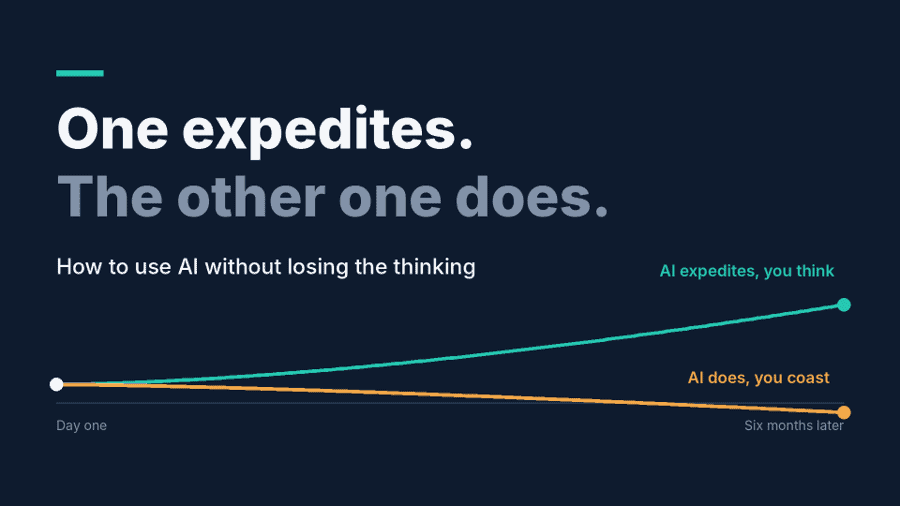
Put two people in front of the same AI tool and give them the same problem. One uses AI to expedite. The other lets AI do.
On day one, you can’t tell them apart. Both ship faster. Both look productive. Both say AI changed how they work.
Six months later, the gap is obvious. The first person is sharper, faster and more valuable than before. The second can’t explain their own work, can’t spot when the output is wrong, and gets stuck the moment the tool does.
I run a software company. I use AI every day, and so does my team. I’m not here to argue against it. I’m here to argue for using it in a way that makes us better, not just busier.
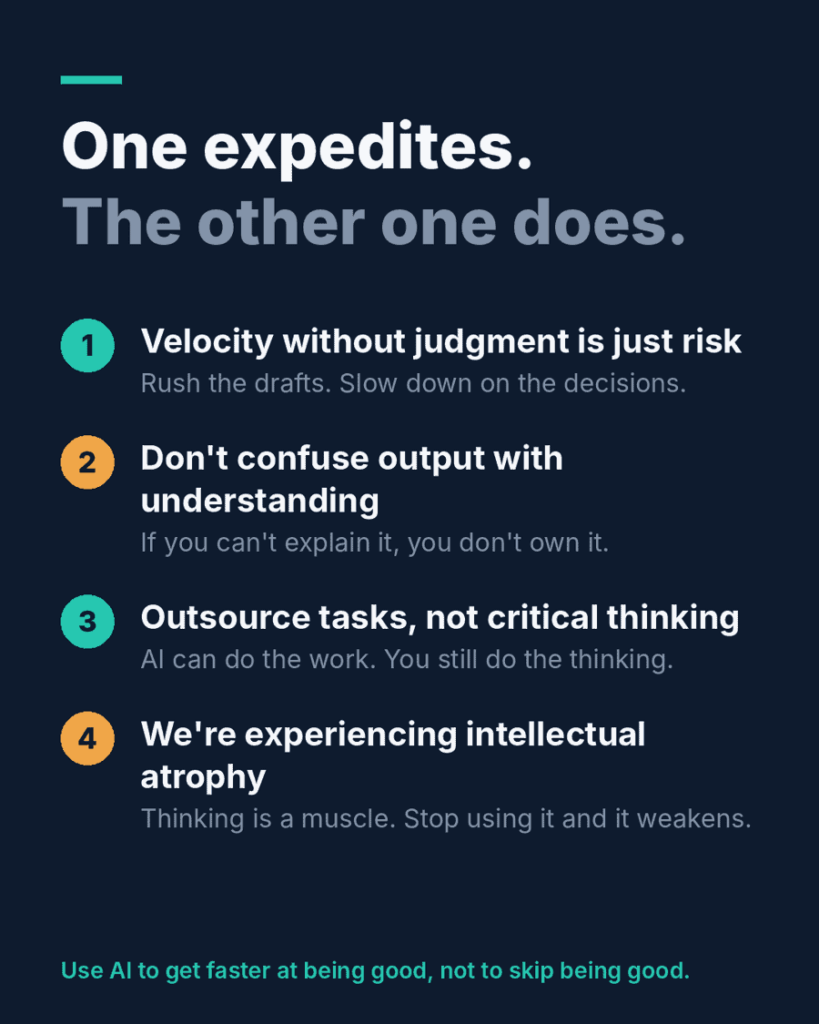
Velocity without judgment is just risk
AI is fast. That’s the pitch, and it’s true. But speed only matters if you’re headed in the right direction.
AI will give you a confident answer in seconds whether it’s right or wrong. It doesn’t slow down when the stakes go up. You have to.
In healthcare tech, where a lot of our work lives, a wrong answer isn’t an awkward email. It can affect a patient. So the question isn’t “how fast can we get this done?” It’s “how sure are we that this is right?”
Being careful doesn’t mean being slow. It means knowing which steps you can rush and which ones you can’t. Let AI take the first draft, the boilerplate, the summary. Slow down at the decisions.
Don’t confuse output with understanding
If you can’t explain it, you don’t own it.
It’s easy to paste an AI answer into a doc, a deck or a codebase and move on. It’s convenient. But if you didn’t understand what you shipped, you can’t defend it, fix it or build on it.
My test is simple. Before something AI-assisted leaves your hands, could you walk someone through it without the tool open? Could you answer the follow-up question? If not, you’re not done.
Copy-paste saves you time today. Understanding saves you when something breaks.
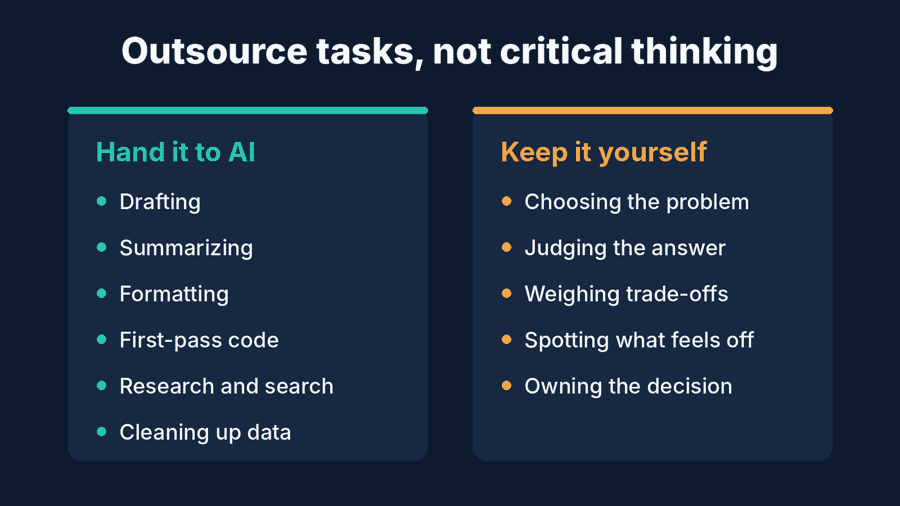
Outsource tasks, not critical thinking
This is the line that matters most.
Tasks are fair game. Drafting, formatting, summarizing, searching, writing first-pass code, cleaning up data. Hand those off happily. That’s where AI earns its keep.
Critical thinking is not a task. Deciding what problem to solve. Judging whether an answer makes sense. Weighing trade-offs. Knowing when something feels off. That’s the job. That’s what people pay you for.
A simple way to think about it: AI can do the work. You still have to do the thinking. The moment you hand over the judgment, you’re no longer using a tool. The tool is using you.
We’re experiencing intellectual atrophy
This isn’t just a hunch. The research is starting to show it.
In 2025, Microsoft Research and Carnegie Mellon surveyed 319 knowledge workers who use generative AI weekly. They found that the more people trusted AI, the less critical thinking they applied to its output. The researchers warned that automation leaves people “atrophied and unprepared” when the exceptions show up.
The same year, MIT Media Lab tracked 54 people writing essays with ChatGPT, with a search engine, or with nothing at all, and measured their brain activity. Over four months, the ChatGPT group underperformed at neural, linguistic and behavioral levels. When they had to write without it, they struggled. The researchers call this “cognitive debt.”
It’s a small study, and it’s early. But anyone who manages people has probably seen it already. Someone who can’t write a clear paragraph without a prompt. A developer who can’t debug code they “wrote.” A team that agrees with whatever the tool says because nobody wants to do the thinking.
Thinking is a muscle. Stop using it and it weakens. That’s not a tech problem. It’s a habit problem.
So how do you use AI well?
A few habits we push on our teams:
- Think first, then prompt: Write down your own take before you ask AI. Then compare. You’ll catch more, and you’ll learn more.
- Verify anything that matters: Facts, numbers, code that touches production or patients. Trust, but check.
- Explain it back: If you can’t explain the output in your own words, don’t ship it.
- Keep some reps manual: Do the hard thing yourself sometimes, even when AI could do it faster. That’s how you stay sharp.
- Own the decision: AI can recommend. A person decides, and a person is accountable.
AI should make you faster at being good, not a faster way to skip being good.
One expedites. The other one does. Choose to be the one who expedites.
How is your team drawing this line? I’d like to hear what’s working.