
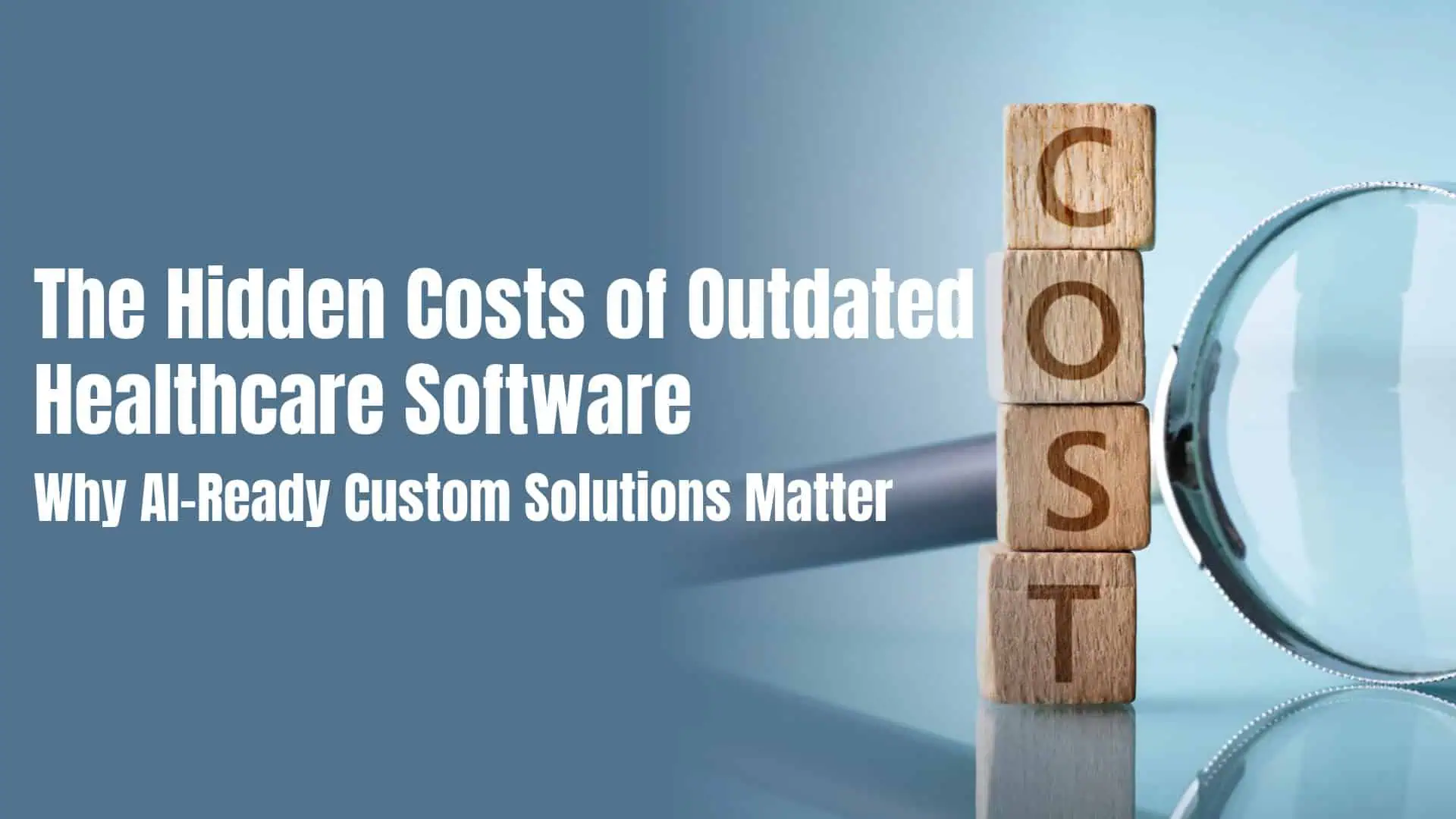





Outdated healthcare software costs more than its maintenance budget. Hidden costs include higher breach exposure, compliance gaps, manual workarounds, lost clinician time, and an inability to deploy AI safely. AI-ready custom software replaces rigid systems with secure, API-first, governed platforms that connect clinical data and support AI without sacrificing HIPAA compliance.
Every healthcare organization in Middle Tennessee runs on software. The real question is whether that software still serves the organization or has quietly started working against it. The Nashville Health Care Council’s 2025 Annual Economic Report found that the region’s health care ecosystem generated $72.1 billion in economic impact and supported 372,160 jobs in 2024. In a market that dense, a clunky patient portal, a brittle integration, or an EHR add-on nobody dares to touch is not a back-office annoyance. It is a competitive and compliance liability.
The bill for outdated healthcare software rarely arrives as one line item. It is spread across breach exposure, compliance rework, staff hours lost to workarounds, and, increasingly, the AI projects that stall because the underlying data cannot move. This guide itemizes those hidden costs with current figures and explains what “AI-ready” custom software means in practice for providers, payers, and healthtech teams, including those weighing healthcare software solutions in Nashville.
Key Takeaways
- Outdated healthcare software is defined by rigidity, not age: if it cannot be secured, integrated, or changed at a reasonable cost, it is outdated.
- Healthcare has had the costliest data breaches of any industry for 13 straight years; IBM’s 2026 average is $6.64 million per breach.
- A pending HIPAA Security Rule overhaul has slipped to at least July 2027, but the current rule is fully enforceable today.
- Legacy system integration and data quality are the top reported barriers to scaling AI in healthcare, according to RSM’s 2026 survey.
- AI-ready does not require a rip-and-replace: incremental, API-first modernization can protect production workflows while opening the door to AI.
What Counts as “Outdated” Healthcare Software?
Outdated healthcare software is any application that can no longer be secured, integrated, or changed at a reasonable cost, regardless of how recently it was purchased. Age is a weak signal. Rigidity is the strong one. A five-year-old platform with no usable API can be more of a liability than a fifteen-year-old system with clean interfaces and an active maintenance plan.
Five warning signs
- Staff re-key data between systems or reconcile exports in spreadsheets.
- Security patches, audit evidence, or access reports require a vendor ticket and a wait.
- New integrations require bespoke interface work every time because there is no modern API (REST or FHIR).
- Leaders cannot get a reliable, current view of operations without a manual report build.
- AI pilots cannot read or write patient or operational data without manual file transfers.
The Hidden Costs of Outdated Healthcare Software
These costs are real but scattered. Security carries one budget, compliance another, and operations a third, so nobody sees the total. Here is how they add up.
1. Security and breach exposure
Healthcare topped IBM’s list of the costliest industries for data breaches for the 13th consecutive year in 2026. The report puts the average healthcare breach at $6.64 million, down 10.5% from $7.42 million a year earlier, while the average U.S. breach across industries reached $11.5 million. A lower number is not a low number.
The same study attributed 59% of healthcare breaches to malicious or criminal attacks, 26% to IT failures, and 13% to human error. Unpatched, poorly maintained, or poorly integrated software is a natural contributor to that IT-failure category. Detection speed matters too: IBM’s 2025 edition found healthcare breaches took an average of 279 days to identify and contain, the longest of any industry, and systems with weak logging and monitoring tend to widen that gap.
2. Compliance drift
HHS proposed the first major overhaul of the HIPAA Security Rule in two decades in January 2025. The proposal would turn safeguards such as encryption and multi-factor authentication into firm requirements. HHS has since pushed final action to at least July 2027. That delay is not a reprieve. The existing Security Rule remains fully enforceable, and OCR has kept bringing enforcement actions, including four ransomware settlements announced in a single 2026 notice. Software that cannot produce audit trails, enforce least-privilege access, or encrypt data end to end forces compliance teams to cover the gap with manual controls and paperwork.
Interoperability rules add pressure. CMS’s Interoperability and Prior Authorization final rule (CMS-0057-F) requires impacted payers to decide standard prior authorization requests within seven days and expedited requests within 72 hours starting January 1, 2026, and to have four FHIR-based APIs operating by January 1, 2027. The rule binds payers, but it reshapes provider workflows too. EHRs and practice systems that cannot exchange data over standard APIs will likely end up on the slow side of an increasingly automated process.
3. Interoperability debt and manual workarounds
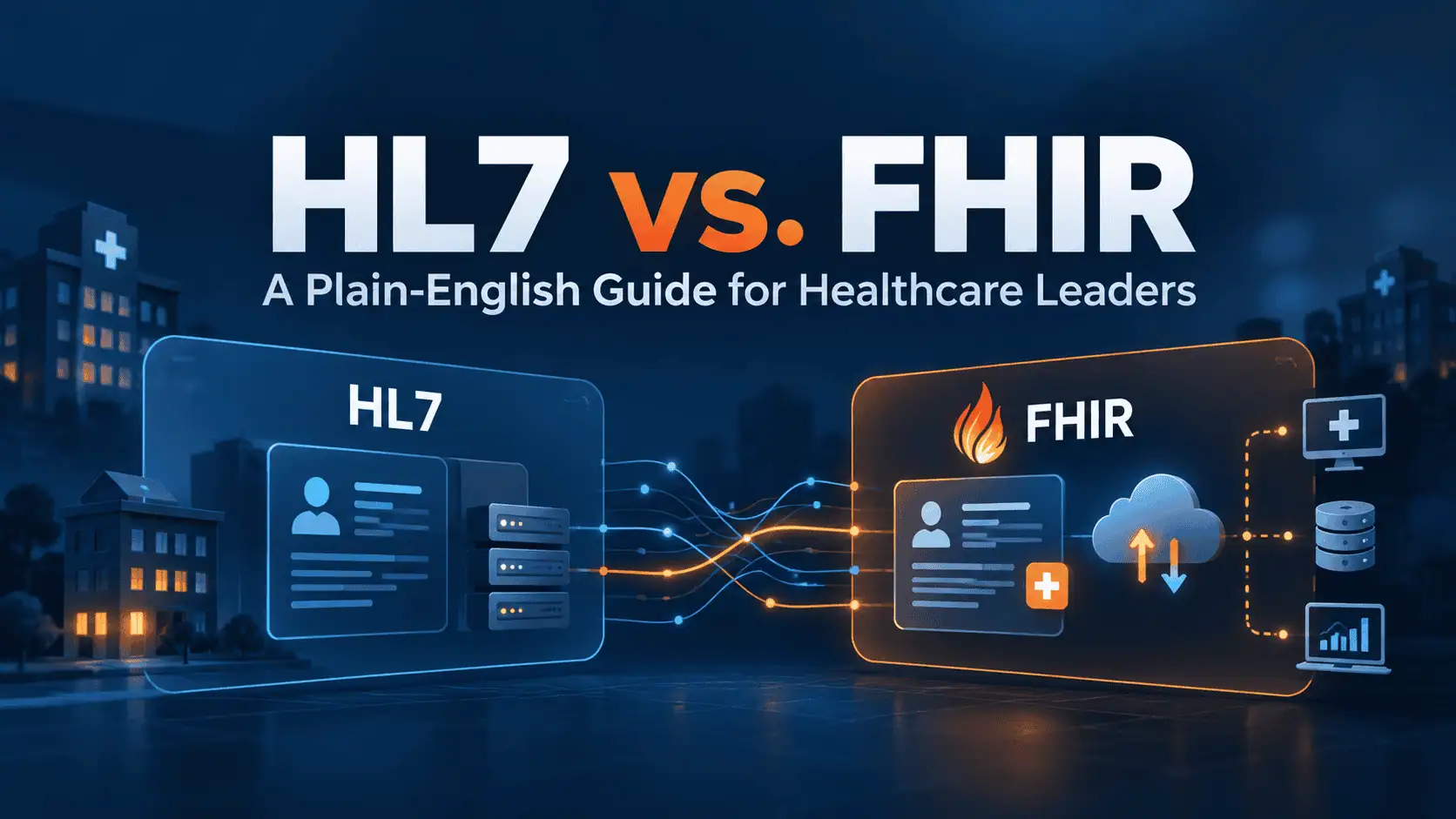
When a system cannot exchange data cleanly, people become the integration layer. They re-key, export, reconcile, and chase duplicates. Those hours never appear in the software budget. ChampSoft has written about how to spot the point where workarounds cost more than a proper fit in its guide to off-the-shelf software that has stopped fitting and about the data exchange standards behind modern integration in its plain-English guide to HL7 and FHIR.
4. Slow change and stalled improvement
Legacy platforms are expensive to change. A new payer rule, a new quality measure, or a new care program turns into a long vendor request or a risky custom patch. Over time, the organization stops asking for improvements because the answer is always “next year.” That opportunity cost never shows up in an audit, but it shapes every strategic decision.
5. The AI opportunity cost
AI is already operational in much of healthcare, and legacy systems are among the main things holding it back. In RSM’s 2026 AI survey, 84% of healthcare respondents whose organizations use AI said it is partially or fully integrated across operations. The top inhibitors were integration with legacy systems (29%) and data quality, availability, and lineage issues (27%). The healthcare sample was small (70 respondents), so treat the figures as directional. RSM also notes that AI exposes upstream data weaknesses rather than fixing them.
The security upside is also tied to modern architecture. IBM found that organizations using security AI and automation extensively cut breach costs by about $1.93 million and shortened breach lifecycles by 65 days. Teams on rigid legacy platforms often cannot deploy that kind of monitoring at all.
The hidden-cost ledger
Use this table as a quick self-audit. If you cannot answer a question in the last column with confidence, that line is probably a hidden cost.
| Hidden cost | Where it shows up | Question to ask your team |
| Breach exposure | Incident response, notification, lost business, higher insurance premiums | When was our last patch cycle and risk analysis, and can we show evidence? |
| Compliance drift | Manual audit prep, remediation projects, late discovery of gaps | Can the system produce audit trails and access reports without a vendor ticket? |
| Interoperability debt | Re-keying, spreadsheet reconciliation, duplicate records | How many hours per week go to moving data between systems by hand? |
| Slow change | Backlogs, long vendor queues, risky one-off patches | How long does a simple workflow change take from request to production? |
| AI opportunity cost | Stalled pilots, manual file transfers, unreliable model inputs | Can an AI tool access clean, governed data through a secure API today? |
What “AI-Ready” Healthcare Software Actually Means
AI-ready healthcare software is software whose data is structured, accessible through secure APIs, governed, and auditable, so AI models can read from and write to clinical and operational workflows without creating compliance or safety risk. It has five traits:
- Standards-based interoperability: HL7, FHIR, and SMART on FHIR interfaces so data moves between EHRs, payers, devices, and analytics tools without bespoke translation each time.
- A governed data foundation: A trusted, de-duplicated source of truth with clear lineage and master data management, so models are not trained or prompted on conflicting records.
- Security and privacy by design: End-to-end encryption, least-privilege access, detailed audit trails, and PHI-safe AI patterns such as private model hosting and controlled inference layers.
- Modular, API-first architecture: The ability to change one workflow without rewriting the whole platform.
- Human oversight and AI governance: Clinical or operational review of AI outputs, plus a governance framework. ISO/IEC 42001 is the international standard for AI management systems.
AI-ready also describes how software gets built. A spec-first, governed approach to AI-augmented software development keeps AI speed from becoming unmanaged AI risk, which matters when the code touches protected health information.
Why Custom Beats Patching (and When It Doesn’t)
Custom is not automatically the answer. If a configurable commercial product fits most of your workflows and exposes modern APIs, extending it is usually smarter. Custom software earns its cost where workflows are differentiated, where data must be unified across several systems, or where integration costs keep compounding. In those cases, Nashville custom software built around your clinical and operational reality can remove the workarounds instead of managing them.
| Dimension | Outdated or ill-fitting system | AI-ready custom solution |
| Security | Patching depends on a vendor; limited logging and monitoring | Security built into the lifecycle: encryption, access controls, audit trails, continuous testing |
| Compliance | Manual evidence gathering and audit prep | Audit-ready by design, with documented controls mapped to HIPAA and related standards |
| Interoperability | Point-to-point interfaces and file transfers | API-first, standards-based exchange (HL7, FHIR) |
| Data for AI | Siloed, inconsistent, hard to extract | Governed, structured, accessible through secure APIs |
| Cost of change | High and unpredictable; vendor-dependent | Modular releases; incremental improvements |
| Staff workload | Re-keying, reconciling, and workarounds | Automated workflows with human review where it matters |
| Ownership | License terms and roadmap controlled by the vendor | Client owns the code and intellectual property (confirm in contract) |
A real-world example of incremental modernization
Modernization does not have to mean replacement. In its Health Cost IQ case study, ChampSoft worked as a data-engineering and platform-support partner on targeted improvements instead of rebuilding the platform. The work automated ingestion across more than 20 vendor file formats, strengthened monitoring, and recovered a critical warehouse-processing workflow that had stalled for several weeks, returning it to typical weekday completion in under an hour.
Why the Nashville Market Raises the Stakes
The Nashville Health Care Council’s 2025 report counts 8,358 healthcare business locations in the region, 17 publicly traded healthcare companies, and more than 900 service providers. A market this dense produces sophisticated buyers: payers, provider groups, and healthtech companies that compare vendors closely and expect compliance evidence up front.
It also means more local choice. Organizations researching healthcare software developers in Nashville can usually find a software development company in Nashville whose teams can meet on-site, run discovery workshops, and shadow clinical workflows alongside. That proximity helps, but it should be one factor among several, not the deciding one.
How to Evaluate a Custom Healthcare Software Partner in Nashville
When comparing the top custom software developers in Nashville, ask for evidence rather than adjectives:
- Compliance proof: HIPAA-aligned practices, a SOC 2 Type II report, and documented security processes (ask to see them).
- Healthcare interoperability depth: real experience with HL7, FHIR, EHR integrations, and PHI-safe data handling.
- AI governance: how AI is used in delivery and in your product, who reviews it, and how data leakage is prevented.
- Ownership: confirm that you own the source code and IP, with no restrictive licensing or lock-in.
- Incremental roadmaps: the ability to modernize a slice at a time instead of demanding a full rewrite.
- End-to-end capability: discovery, design, build, cloud and DevOps, testing, security validation, documentation, handover, and ongoing support from one accountable team.
Final note on local fit: a Nashville office is useful for workshops and relationship building, but the engineering process behind it determines security, quality, and long-term cost.
How ChampSoft Approaches Healthcare Modernization
ChampSoft is a software engineering and AI development company founded in 2010, with a U.S. office in Brentwood, Tennessee, in the Nashville metro area. It holds HIPAA compliance, SOC 2 Type II, ISO 9001, and ISO/IEC 42001 credentials (see its accreditation and compliance page). For healthcare teams, that translates into end-to-end software delivery services in Nashville and beyond that cover:
- Healthcare-specific platforms: EHR/EMR systems, telehealth, patient portals, revenue cycle tools, population health analytics, and mobile and IoT solutions, as described on its healthcare industry page.
- Interoperability: HL7, FHIR, and SMART on FHIR integrations and health information exchange, delivered through its system integration practice.
- An AI software development service for healthcare: AI-driven clinical documentation, decision support, and chatbots, plus business-logic transformation. ChampSoft states that its AI workflows are designed to be HIPAA-compliant, with private model hosting and controlled inference layers.
- Governed, spec-first delivery: AI-augmented development with mandatory human oversight, secure SDLC controls, and automated testing, so teams that want AI-augmented software development in Nashville get speed without unmanaged risk.
- Client ownership: ChampSoft states that clients own 100% of their software, source code, and IP.
According to ChampSoft’s own figures, its healthcare work spans 300+ projects with 50+ AI systems in production, and clients report 35–50% operational efficiency gains with returns in 8 to 12 months. These are company-reported numbers; ask for references that match your use case.
Ready to find out what outdated software is really costing you? Talk to ChampSoft’s healthcare engineering team.
The Bottom Line
Outdated healthcare software is expensive in ways that rarely appear on a single invoice: breach exposure, compliance drift, manual workarounds, slow change, and AI projects that never get past the pilot. The fix is not always a full rewrite. Start by auditing where data gets stuck, modernize the highest-friction pieces first, and build on secure, standards-based, governed foundations so AI can be added safely. Organizations that do this now will be better placed when the next rule, payer requirement, or AI opportunity arrives.
FAQs
What are the hidden costs of outdated healthcare software?
The hidden costs of outdated healthcare software include higher data breach exposure, compliance rework, staff hours lost to manual workarounds, slow response to new regulatory and payer requirements, and the inability to adopt AI because data cannot move between systems. These costs are spread across budgets, which is why they are rarely tallied in one place.
How much does a healthcare data breach cost?
IBM’s 2026 Cost of a Data Breach Report puts the average healthcare breach at $6.64 million, the highest of any industry for the 13th consecutive year. The average U.S. breach across all industries reached $11.5 million. Costs vary widely with breach size, detection time, and regulatory response.
What does AI-ready healthcare software mean?
AI-ready healthcare software has structured and governed data, secure APIs built on standards such as HL7 and FHIR, audit trails, modular architecture, and human oversight of AI outputs. These features let AI tools read from and write to clinical and operational workflows without creating privacy, safety, or compliance risk.
Do we have to replace our entire system to become AI-ready?
No. Many organizations modernize incrementally by adding an integration layer, cleaning data pipelines, and replacing the highest-friction modules first. This approach lowers risk and keeps production workflows running while the architecture improves.
Is the HIPAA Security Rule changing?
HHS proposed a major update to the HIPAA Security Rule in January 2025, but as of mid-2026, the update is not final, and HHS has pushed its target for final action to at least July 2027. The existing Security Rule remains fully in effect and enforceable, so organizations should not wait for the final rule to address known gaps.
Why work with a Nashville-based custom healthcare software developer?
Nashville is home to one of the largest healthcare ecosystems in the country, with 900+ healthcare service providers and 17 publicly traded healthcare companies. A local partner can run on-site discovery, understand regional payer and provider dynamics, and meet clinical teams in person, while still delivering through a secure, compliant engineering process.
How does AI-augmented software development reduce risk?
AI-augmented development uses AI to speed up requirements, scaffolding, testing, and documentation while human engineers stay accountable for design, security, and correctness. Governed approaches add spec-first planning, mandatory code review, automated testing, and traceability, which keeps AI speed from becoming unmanaged AI risk.