
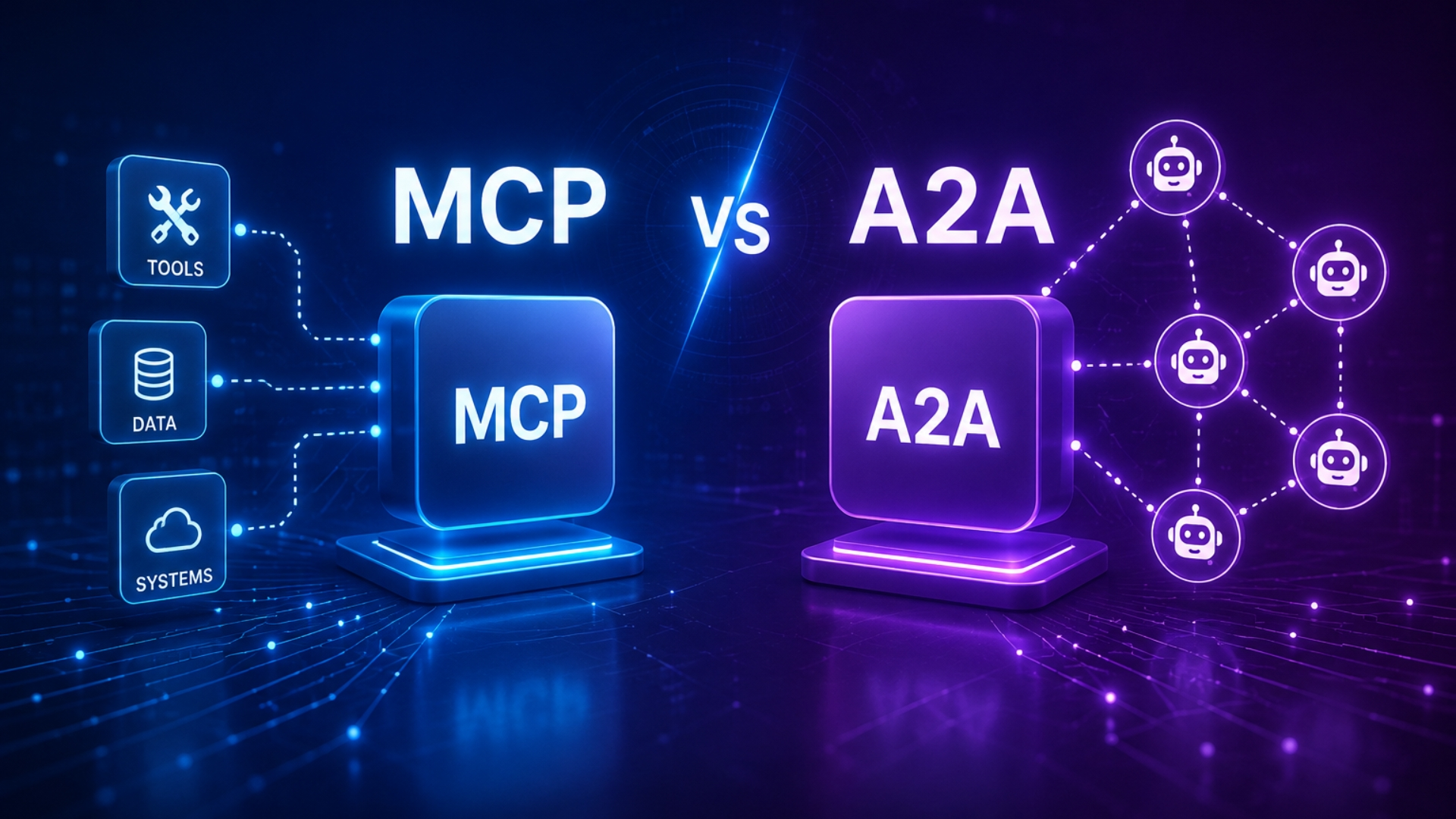





MCP and A2A solve different integration problems. Model Context Protocol standardizes how an AI application or agent accesses tools, data, and reusable capabilities. Agent2Agent Protocol standardizes how independent agents discover one another, delegate work, and exchange results. MCP supports agent-to-tool communication; A2A supports agent-to-agent communication. Enterprise architectures may use either protocol or both together.
Enterprise AI is moving beyond standalone chatbots. Modern agents are expected to retrieve live data, operate business systems, coordinate with specialized services, maintain task state, and return auditable results. That creates two separate integration challenges: connecting an agent to capabilities and connecting one agent to another.
The Model Context Protocol (MCP) addresses the first issue. Agent2Agent Protocol (A2A) addresses the second. Treating them as competing standards creates a confusing architecture. The more useful question is where each protocol belongs, what risks it introduces, and when a conventional API is still the simpler choice.
Key Takeaways
- MCP connects AI applications and agents to tools, resources, prompts, and external systems through a standardized client-host-server model.
- A2A connects independent agents so they can advertise skills, exchange messages, delegate tasks, and return artifacts without exposing their internal reasoning or tools.
- MCP and A2A complement each other: an orchestrator can delegate a task through A2A while the specialist agent uses MCP to access the systems required to complete it.
- Neither protocol automatically makes an AI system secure. Identity, least privilege, token handling, approval gates, sandboxing, monitoring and auditability remain implementation responsibilities.
- Enterprises should keep conventional APIs for deterministic service contracts and introduce agent protocols only where discovery, delegation or AI-native interoperability creates measurable value.
Why MCP and A2A Matter in 2026
The enterprise agent ecosystem is becoming heterogeneous. A single workflow may involve a model from one provider, a cloud-hosted orchestration layer, internal systems owned by several teams, and specialist agents supplied by external vendors. Without shared protocols, every connection becomes custom integration code with its own schemas, authentication flow, error behavior, and maintenance burden.
What Is Model Context Protocol?
The Model Context standard is an open standard for linking AI applications to outside resources. A useful mental model is to treat MCP as an AI-oriented capability layer. Instead of embedding a unique integration for every database, SaaS platform, or file store, an AI host can connect to MCP servers that describe what they provide and how to invoke those capabilities.
The three MCP components
- Host: The application that coordinates the user experience, model interaction, security boundaries, client lifecycle, consent, and context aggregation.
- Client: A host-created protocol element. Each client maintains a one-to-one relationship with one MCP server and routes protocol messages.
- Server: A focused provider of tools, resources, prompts, or other supported capabilities. A server may run locally or as a remote service.
What MCP is good at
- Letting an agent discover and invoke approved enterprise tools.
- Retrieving governed context from databases, document stores, and knowledge systems.
- Standardizing access to repeatable functions such as searching, creating records, generating reports, or triggering workflows.
- Reducing repeated adapter code when several AI applications need the same underlying capability.
- Keeping orchestration and broad conversation context in the host while limiting what each MCP server receives.
Important limitation: MCP standardizes interaction with capabilities; it does not automatically determine whether a tool is trustworthy, whether the user is authorized to invoke it, or whether an action should proceed without human approval.
What Is Agent2Agent Protocol?
The Agent2Agent Protocol is an open standard for communication between separate AI agent systems. These agents may use different models, frameworks, languages, and infrastructure. A2A lets them advertise capabilities, exchange messages, coordinate tasks, and return artifacts without needing access to one another’s internal memory, orchestration logic, or tool implementations.
A2A 1.0 centers on several enterprise-oriented concepts: Agent Cards for discovery, messages for communication, tasks for stateful work, artifacts for results, and support for streaming or asynchronous updates. The specification defines JSON-RPC, gRPC, and HTTP+JSON/REST protocol bindings.
Core A2A concepts
- Agent Card: A machine-readable description of an agent’s identity, skills, interfaces, security schemes, and supported features. Version 1.0 also supports signatures for verification.
- Message: A communication between the A2A client and server agent containing text, files, or structured data.
- Task: A stateful unit of work that can move through states such as submitted, working, completed, failed, canceled, rejected, input required, or authorization required.
- Artifact: A result produced by the agent, such as a report, file, structured dataset, or other output.
- Streaming and push notifications: Delivery patterns for incremental results and long-running work that should not depend on one synchronous request.
What A2A is good at
- Delegating a business outcome to a specialist agent whose internal implementation remains opaque.
- Coordinating agents operated by different teams, vendors or cloud platforms.
- Supporting long-running tasks that need status changes, follow-up input or asynchronous completion.
- Exchanging complex results as structured artifacts rather than raw tool responses.
- Reducing tight coupling between an orchestrator and the internal tools used by a specialist agent.
MCP vs A2A: Side-by-Side Comparison
| Primary job | Connect an AI application or agent to tools, resources, prompts and external capabilities. | Enable independent agents to discover, communicate, delegate and manage collaborative work. |
| Relationship | Host-to-server capability access through one client per MCP server. | A2A client agent to A2A server agent, potentially across teams, vendors or organizations. |
| Core abstraction | Tools, resources and prompts exposed by an MCP server. | Messages, tasks, artifacts, Agent Cards and task state. |
| State model | The July 2026 specification defines MCP as stateless; each request carries its protocol version and capabilities. | Task-oriented and designed for multi-turn, streaming and long-running asynchronous work. |
| Discovery | Clients discover server capabilities declared through the protocol. | Agent Cards advertise identity, skills, interfaces, security schemes and supported capabilities. |
| Typical output | Structured tool result, resource content, prompt or client-assisted interaction. | Message, task status update or artifact produced by an agent. |
| Best fit | Databases, file systems, SaaS applications, internal APIs and reusable enterprise tools. | Specialist agents, cross-platform delegation, long-running workflows and multi-agent ecosystems. |
| Security focus | Host isolation, consent, resource-bound tokens, OAuth protections and least-privilege tool access. | Agent identity, scoped task authorization, Agent Card verification, task ownership and secure callbacks. |
| Does it replace APIs? | No. MCP often wraps or brokers existing APIs as AI-readable capabilities. | No. A2A coordinates agent-level work while agents still rely on APIs and tools internally. |
The Simplest Difference: Capability Access vs Agent Collaboration
MCP answers: How can this AI application use a capability or access a resource? A2A answers: How can this agent ask another independent agent to complete or contribute to a task?
That distinction matters because tools and agents are not interchangeable. A tool generally exposes a defined operation: search these records, create this ticket, or retrieve this document. With a more general objective, an agent can plan, use several tools, ask for clarification, handle intermediate failures, and return a completed artifact.
For example, an invoice tool might expose functions to retrieve and update invoice records. A finance agent could accept the higher-level request, ‘Investigate the disputed invoice, compare the contract terms, identify the likely cause, and draft a resolution.’ The finance agent may use several MCP tools internally. Still, the orchestrator interacts with the finance agent through A2A because the delegated unit is an outcome, not a single function call.
How MCP and A2A Work Together
In a combined architecture, the orchestrator receives a user request and applies policy. It can use MCP directly for straightforward capability access. When the request requires specialized reasoning or a separately operated service, the orchestrator delegates through A2A. The specialist agent then uses its own approved MCP servers or APIs to complete the work and returns an artifact or task result.
Example: Enterprise procurement workflow
- A procurement manager asks the orchestrator to evaluate a purchase request and recommend a supplier.
- The orchestrator uses MCP to retrieve the request, budget and approved-supplier list from internal systems.
- It delegates market evaluation to an independent supplier-intelligence agent through A2A.
- The specialist agent uses its own MCP tools or APIs to collect prices, delivery estimates, and risk indicators.
- The specialist returns a structured comparison artifact through A2A.
- The orchestrator combines the artifact with internal policy, generates a recommendation, and pauses for human approval before any purchase commitment.
- After approval, a narrowly scoped MCP tool creates the purchase order and records the audit evidence.
Should You Use MCP, A2A or Both?
| Scenario | Recommended approach | Reason |
| The agent needs to query a database or call a business application | MCP or a conventional API | Use MCP when reusable discovery and standardized AI-tool integration add value. |
| One agent delegates a complex outcome to an independent specialist | A2A | The specialist owns its reasoning, tools and task lifecycle. |
| An agent delegates to a specialist that must use enterprise systems | A2A + MCP | A2A handles delegation; MCP handles the specialist’s tool and data access. |
| The interaction is deterministic, narrow and already stable | Conventional API | Do not add an agent protocol when a normal service contract is simpler. |
| The workflow includes irreversible or high-risk actions | Protocol plus approval controls | Require explicit policy checks and human approval regardless of protocol. |
The ChampSoft MCP–A2A Enterprise Decision Framework
Use the protocol that matches the relationship being governed, then add controls based on the action’s impact. This framework helps prevent teams from turning every integration into an agent or wrapping every stable API without a clear benefit.
| Architecture requirement | Recommended choice | Required control |
| Agent accesses a database, SaaS tool, file store, or internal service | MCP | Allowlisted capabilities, scoped identity, and input/output validation |
| One independent agent delegates an outcome to another | A2A | Verified Agent Card, task-scoped authorization, and traceable task state |
| Orchestrator delegates to a specialist that must access enterprise systems | A2A + MCP | End-to-end identity, data minimization, correlation IDs, and policy enforcement |
| Operation is narrow, deterministic, and stable | Conventional API | Contract validation, authentication, authorization, and observability |
| Action is financial, clinical, legal, security-sensitive, or irreversible | API or MCP/A2A with an approval gate | Human approval of the exact action and parameters immediately before execution |
| Workflow crosses vendors or organizational boundaries | A2A + MCP or APIs | Vendor trust policy, tenant isolation, explicit data-sharing rules, and revocation |
The decision is not purely technical. Teams should also evaluate operational ownership, compliance obligations, latency, cost, failure recovery, and whether autonomous delegation produces enough value to justify the additional attack surface.
When MCP alone is enough
Use MCP without A2A when one host or agent mainly needs standardized access to tools and data. Examples include querying an internal knowledge system, updating a CRM, generating a document from governed data, or initiating an approved workflow. If the interaction can be expressed as well-defined capabilities under one orchestration boundary, adding an independent agent layer may create unnecessary complexity.
When A2A adds value
Use A2A when the delegated party is an independent agent that owns expertise, state, and execution. This is especially useful across platform, team, or organizational boundaries; for long-running work; and when the requesting agent should not depend on the specialist’s internal implementation.
When both protocols belong
Use both when a multi-agent workflow must coordinate autonomous specialists and those specialists also need secure access to tools or enterprise systems. A2A becomes the collaboration plane, while MCP becomes a capability-access plane beneath individual agents.
When a Conventional API Is Better
Do not adopt an agent protocol merely because it is new. A normal API remains appropriate when the contract is deterministic, the caller already knows the endpoint, the operation has stable inputs and outputs, and no agent discovery or task lifecycle is required. Mature enterprise architecture will use conventional APIs, events, MCP, and A2A together, each at the layer where it provides the clearest value.
MCP and A2A Security Risks for Enterprise AI Agents
Interoperability expands the attack surface. An agent can interpret untrusted content, select tools, send data to external services, and trigger actions. A secure implementation must govern identity, permissions, data flow, and action authority across every protocol boundary.
1. Overprivileged tools and agents
An agent that inherits broad user or service permissions can act far beyond its current task. Use separate workload identities, task-specific scopes, explicit allowlists, and short-lived credentials. Do not give a general-purpose agent administrator-level access simply because it may occasionally need a privileged operation.
2. Token misuse and passthrough
The MCP authorization specification requires tokens to be issued for and bound to their intended resource. Its security guidance also prohibits token passthrough to downstream APIs. Treat each service boundary as a separate authorization decision. Validate token audience, issuer, scope, and expiry, and obtain a distinct upstream token when the MCP server calls another protected service.
3. Prompt injection through tools, resources or Agent Cards
Malicious instructions can arrive through retrieved documents, web content, tool results, or descriptive metadata. Keep untrusted content separate from system instructions, validate structured fields, restrict which tools can be selected, and never treat natural-language capability descriptions as proof of trust. An Agent Card may describe what an agent claims to do; identity and authorization controls determine whether it may participate.
4. Agent impersonation and discovery poisoning
The A2A specification supports Agent Card signing and verification, but an enterprise still needs a trust policy: approved issuers, certificate or key validation, controlled registries, cache rules, and revocation processes. Do not allow an orchestrator to discover and trust arbitrary agents from the public internet solely because they publish a valid-looking card.
5. Unsafe side effects
Reading a report and transferring money are not equivalent actions. Classify tools and tasks by impact. Require explicit approval for irreversible, financial, clinical, legal, security-sensitive, or externally visible actions. Approval must apply to the concrete action and parameters, not merely to a vague high-level plan.
6. Data leakage across agents
A2A makes cross-agent exchange easier, but the requesting agent should send only the data needed for the delegated task. Apply classification, minimization, masking, tenant isolation, retention limits, and outbound-content checks. Do not forward an entire conversation or dataset when a bounded summary or reference is sufficient.
7. Weak observability and accountability
Distributed agent workflows are difficult to investigate without end-to-end traces. Record the requesting identity, delegated agent, tool selected, authorization decision, inputs, material outputs, model and protocol versions, approval events, task state changes, failures and final business action. Protect logs from alteration and avoid placing secrets or unnecessary sensitive data in them.
Enterprise Security Checklist
- Maintain a verified inventory of MCP servers, A2A agents, owners, versions and approved environments.
- Assign distinct machine identities to agents and protocol services; do not rely on shared service accounts.
- Use least-privilege, short-lived and audience-bound credentials with explicit scopes.
- Verify A2A Agent Cards and restrict discovery to approved registries or allowlisted domains.
- Classify every tool and delegated task by read, write, external communication, financial, and irreversible impact.
- Require human approval for high-impact actions and revalidate the exact parameters at execution time.
- Treat retrieved content, tool results, messages, and agent metadata as untrusted input.
- Validate schemas, sanitize outputs, and constrain network egress from agents and tool runtimes.
- Use tenant isolation, data minimization, encryption and retention policies across agent boundaries.
- Propagate correlation identifiers and capture structured audit evidence for every task and tool call.
- Test prompt injection, malicious tool responses, recursive calls, timeout behavior, retries and partial failure.
- Maintain kill switches, revocation procedures, fallback workflows and incident-response playbooks.
A Practical MCP and A2A Implementation Roadmap
- Start with a bounded business outcome. Choose one workflow with measurable value, known data owners, and limited irreversible impact. Avoid beginning with an enterprise-wide autonomous-agent platform.
- Map capabilities and trust boundaries. Identify users, agents, MCP servers, A2A endpoints, data classifications, external parties, and every point where authority changes hands.
- Separate tools from agents. Represent deterministic operations as tools or APIs. Represent independent, stateful expertise as agents. This prevents unnecessary multi-agent complexity.
- Define identity and authorization first. Decide how users, agents, and services authenticate; how scopes are issued; which actions require approval; and how credentials are rotated and revoked.
- Build the smallest protocol layer. Introduce MCP for a small set of read-only tools or A2A for one specialist delegation. Confirm value and operational behavior before combining both.
- Add observability before autonomy. Capture traces, task state, tool invocations, errors, policy outcomes, cost, and latency before enabling broader action permissions.
- Test adversarial and failure scenarios. Evaluate malicious content, unavailable services, duplicated requests, tool timeouts, agent loops, partial results, and attempts to exceed permissions.
- Introduce controlled write actions. Add narrow, reversible write operations with parameter validation and explicit approval. Expand only when audit evidence shows stable behavior.
- Govern change continuously. Version protocols, prompts, tools, Agent Cards, policies, and models. Reassess risk when a capability, vendor, or data source changes.
How to Measure Production Success
| Metric category | What to track |
| Business outcome | Cycle-time reduction, completion rate, avoided manual handoffs and quality of the finished result. |
| Reliability | Task success rate, tool error rate, retry rate, timeout rate, duplicate actions and recovery success. |
| Security | Denied over-scope attempts, approval compliance, credential failures, policy violations and data-loss events. |
| Performance | End-to-end latency, time by agent and tool, streaming responsiveness and queue duration. |
| Cost | Model tokens, tool and API charges, infrastructure cost and cost per completed business outcome. |
| Governance | Percentage of agents and tools with owners, current risk assessments, test evidence and supported versions. |
Common MCP and A2A Implementation Mistakes
- Calling the protocols competitors: This leads teams to select one standard for problems it was not designed to solve.
- Wrapping every API in MCP: Stable deterministic services may not benefit from an added protocol layer.
- Turning every capability into an agent: A narrow function does not need planning, memory, or a task lifecycle.
- Trusting discovery metadata: Capability descriptions support routing; they do not replace identity verification, authorization, or vendor review.
- Using one powerful service identity: Shared broad credentials make least privilege, attribution, and incident containment difficult.
- Logging only the final answer: Investigation requires the task, delegation, tool, approval, and policy history, not merely the output shown to the user.
- Skipping failure design: Multi-agent systems need idempotency, timeouts, cancellation, retry limits, fallbacks, and clear ownership of partial work.
How ChampSoft Can Support Enterprise AI-Agent Architecture
MCP and A2A adoption is not only a protocol decision. Production success depends on data architecture, API integration, cloud foundations, identity, observability, security testing, and governance. ChampSoft can help organizations assess where agent protocols add value, design bounded reference architectures, and integrate AI workflows with existing enterprise platforms.
ChampSoft’s Data & AI, system integration, and cloud architecture capabilities are relevant to this work: governed AI systems, secure API-driven integration, identity and access patterns, event-driven workflows, reliability engineering, and production observability. ChampSoft’s ISO/IEC 42001 certification supports structured responsibility, AI risk management, and continuous oversight, but certification should not be treated as proof that a specific MCP or A2A implementation is automatically secure.
Planning an enterprise agent architecture? ChampSoft can help evaluate the workflow, map protocol and trust boundaries, create a secure proof of concept, and build a phased path to production. Schedule a consultation.
Conclusion
MCP and A2A are becoming important parts of the enterprise agent stack because they standardize two different relationships. MCP gives AI applications a consistent way to access tools and data. A2A gives independent agents a common way to discover one another, coordinate work, and exchange results.
The strongest architecture does not select protocols by popularity. It separates deterministic capabilities from autonomous expertise, preserves conventional APIs where they remain sufficient, and applies identity, least privilege, human oversight, and observability across every boundary. For many organizations, that means MCP beneath agents, A2A between agents, and governance across the complete workflow.
FAQs
What is the main difference between MCP and A2A?
MCP standardizes how AI applications and agents connect to tools, data sources, and reusable capabilities. A2A standardizes how independent agents discover one another, exchange messages, delegate tasks, and return results. MCP is capability access; A2A is agent collaboration.
Does A2A replace MCP?
No. A2A and MCP solve different problems and can be used together. An agent may receive a delegated task through A2A and then use MCP servers to access the tools and data required to complete it.
Can MCP connect one AI agent to another?
An MCP server can expose almost any capability, including one backed by an agent. However, MCP’s core abstraction is capability and context exchange. A2A is designed specifically for independent agents, task state, multi-turn work, artifacts, discovery, and asynchronous collaboration.
Do MCP and A2A replace REST APIs?
No. Both protocols frequently rely on existing APIs and web infrastructure. Conventional APIs remain appropriate for deterministic service contracts. MCP adds an AI-oriented capability layer, while A2A adds an agent collaboration layer.
Is MCP secure by default?
No protocol removes the need for secure implementation. MCP defines authorization and security requirements, but teams must still validate servers, scope permissions, protect tokens, isolate untrusted content, control tool side effects, and maintain audit logs.
What is an A2A Agent Card?
An Agent Card is a machine-readable document that describes an agent’s identity, skills, interfaces, security schemes, and supported capabilities. Enterprises should verify its origin and apply allowlists or registry controls rather than automatically trusting every published card.
When should an enterprise use both MCP and A2A?
Use both when an orchestrator must delegate complex outcomes to independent specialist agents and those agents need standardized access to enterprise tools or data. A2A coordinates the agents; MCP connects individual agents to capabilities.
How should a company begin adopting agent protocols?
Start with one bounded, measurable, and low-risk workflow. Map identities and trust boundaries, implement least privilege and observability, test failure and attack scenarios, and add write permissions only after the read-only architecture is stable.