
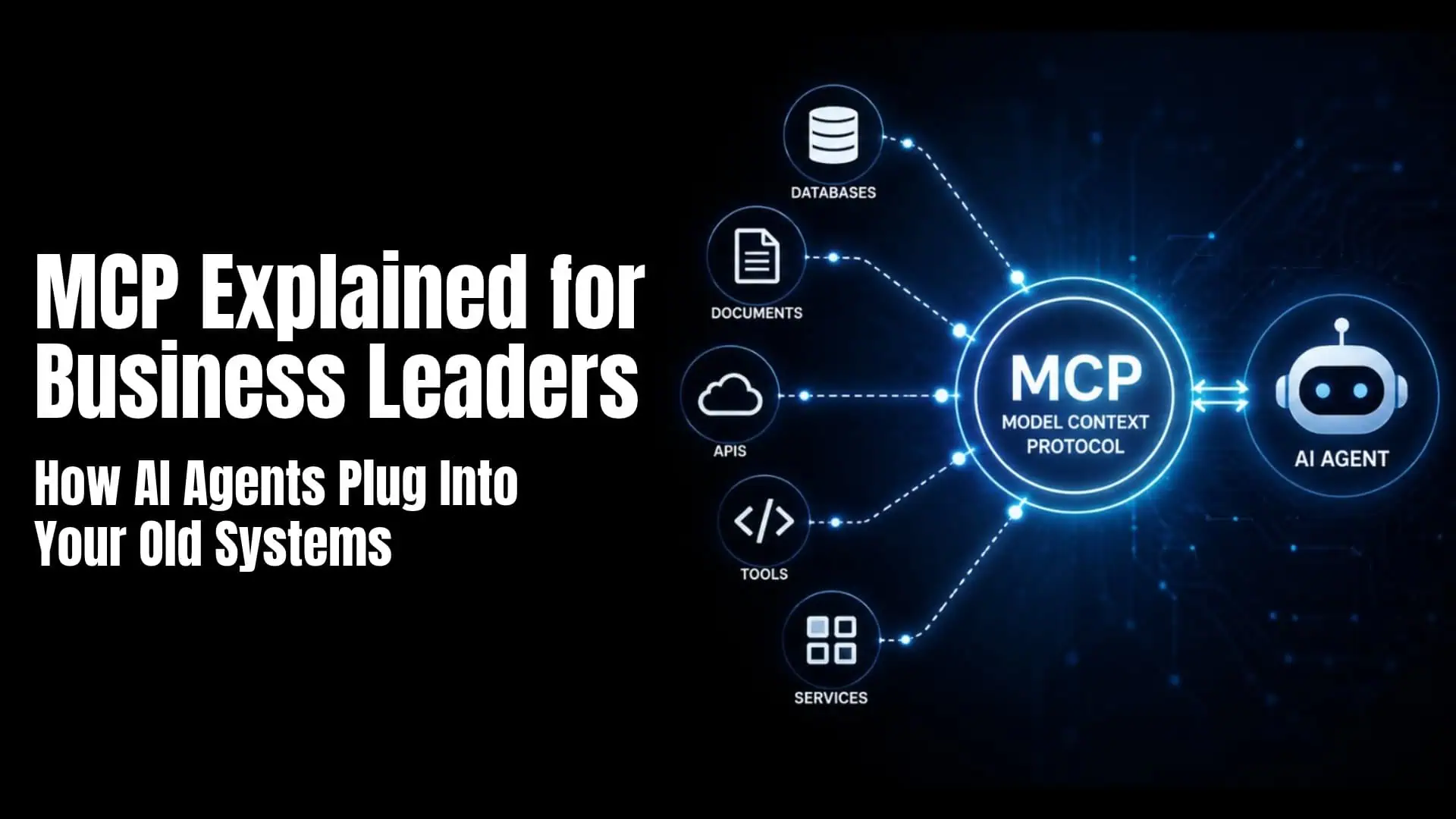





The Model Context Protocol (MCP) is an open standard that lets AI agents connect to business systems, such as core banking, e-commerce platforms, and health records, through one consistent interface instead of custom integrations. For leaders, MCP shortens integration time, keeps legacy systems in place, and makes agent access governable and auditable.
Your AI pilot works. The demo impressed everyone. Then someone asks the hard question: can it actually see our customer records, our claims queue, or the fifteen-year-old billing platform nobody wants to touch? That is where most AI agent projects stall, and it is the problem the Model Context Protocol (MCP) was built to solve.
MCP has gone from a developer curiosity to a board-level topic in about two years. Banks are introducing MCP servers to support essential banking operations. Retailers and payment providers are exposing catalogs and checkout through it. In healthcare, federal regulators have signaled interest in pairing FHIR with MCP as the HTI-6 rulemaking approaches. This guide explains MCP in plain English, shows how AI agents connect to legacy systems, covers the risks, and shows where an experienced engineering partner like ChampSoft fits.
Key Takeaways
- MCP is an open standard that gives AI agents one consistent way to discover and use the tools and data inside your business systems.
- It lets you keep proven legacy platforms in place and add an AI-ready layer on top, instead of a risky rip-and-replace.
- Adoption is broad: banking, payments, retail, and healthcare policy discussions all reference it.
- MCP does not make agents safe by itself. Permissions, audit trails, and governance decide whether an integration is production-ready.
- The best first step is a scoped pilot on one workflow, built spec-first with security and compliance designed in.
What Is MCP? A Plain-English Explanation
The Model Context Protocol is an open standard, introduced by Anthropic in November 2024, that defines how AI applications communicate with external tools, data sources, and systems. A common comparison is a USB-C port for AI: instead of a different cable for every device, one standard connector works across many.
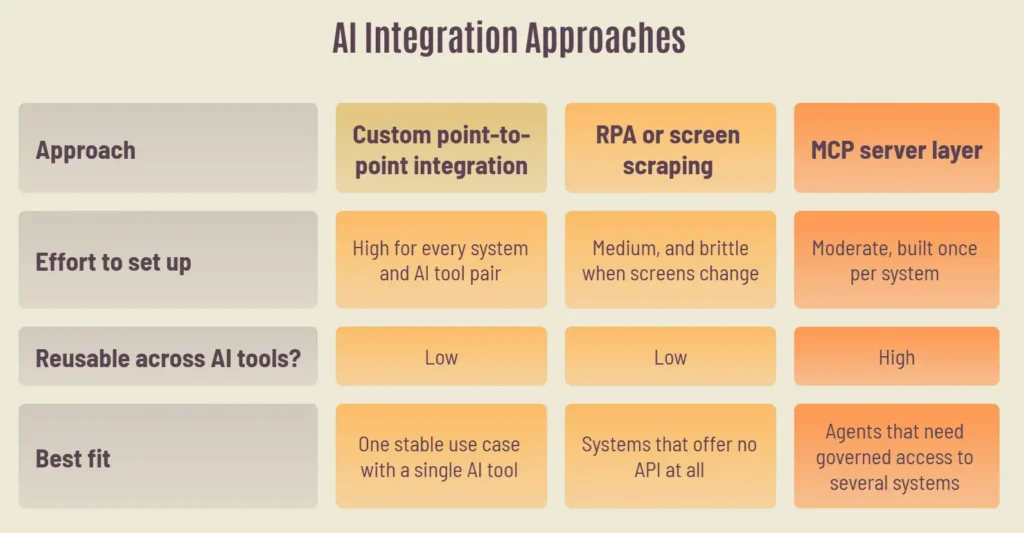
Before MCP, connecting AI models to a CRM, a database, and a document store meant building a separate custom integration for every pairing. With three AI tools and ten systems, that is thirty integrations to build and maintain. MCP turns that into a build-once model. You wrap each system in an MCP server one time, and any MCP-compatible AI application can use it.
The three pieces, without the jargon
- Host: the AI application your people use, such as an assistant, a copilot, or an internal agent.
- Client: the connector inside the host that maintains a dedicated link to each server.
- Server: a lightweight service that exposes a system’s capabilities, such as searching a catalog, checking an order, or retrieving a patient summary, as tools the agent can discover and call.
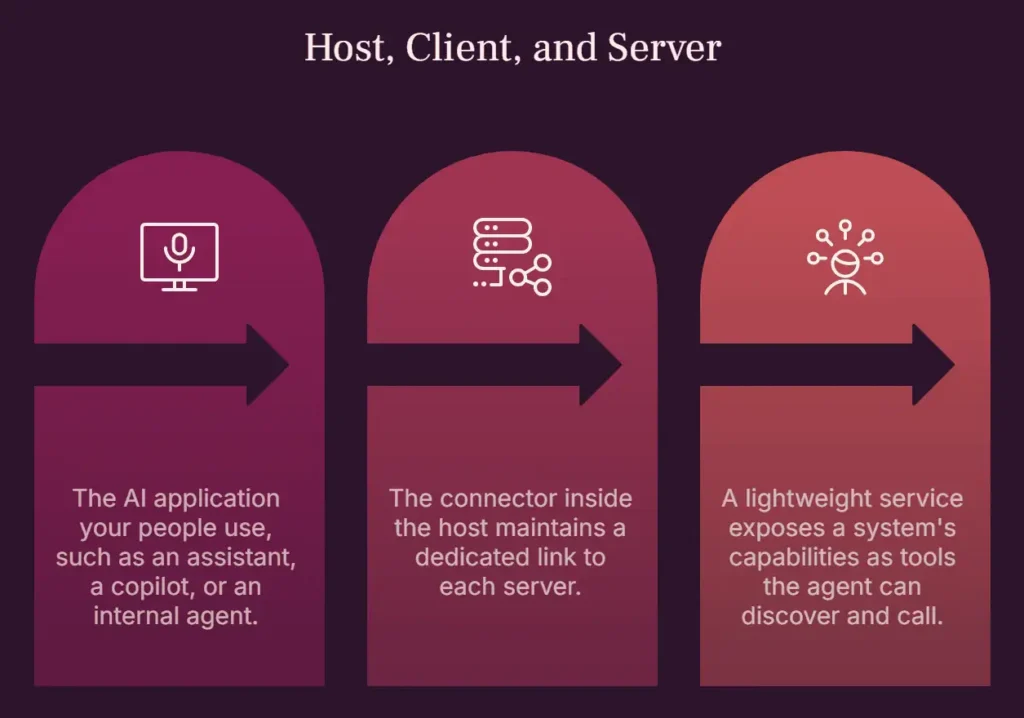
The agent does not need to know how your system works internally. It asks the server what is available, requests an action, and the server runs it under the permissions you have set.
Why Business Leaders Should Care Now
MCP is no longer experimental. Industry tracking reported more than 10,000 MCP servers in production by mid-2026, with SDK downloads in the tens of millions each month. In December 2025, the protocol moved under the Linux Foundation’s Agentic AI Foundation, giving it neutral, vendor-independent governance. In July 2026, the maintainers released the largest specification revision since launch, making the protocol stateless at its core, which simplifies running it at scale in the cloud.
For decision-makers, that backing matters. A widely supported standard is a safer investment than a proprietary integration that may be obsolete in two years.
How AI Agents Plug Into Your Old Systems
Most enterprises run on platforms that were never designed for AI: core banking systems, on-premise ERPs, and custom applications with thin documentation. MCP does not require you to replace them. A thin layer sits in front of the legacy system, and the agent talks to that layer. A typical rollout looks like this:
- Pick one workflow with clear value, such as claims status lookups or order exception handling.
- Expose only the necessary functions through an MCP server that wraps the existing API, database view, or service.
- Set permissions per tool: read-only first, then tightly scoped write actions with human approval.
- Log every tool call so compliance and security teams can audit what the agent did and why.
- Measure results, then repeat for the next workflow.
Read first, write later
Start with read-only access. An agent that retrieves a balance or an order status carries far less risk than one that moves money or edits a record. Add write actions only after guardrails, approvals, and rollback paths are tested.
What MCP is not
MCP is not an AI model, a replacement for your APIs, or a payment or compliance framework. It is the connection layer. Your existing systems still do the work; MCP gives agents a governed way to ask for it. In payments, for example, MCP handles tool discovery and invocation, while separate protocols handle checkout and authorization.
MCP in the Real World: Banking, Retail, and Healthcare
Banking: a controlled doorway to core systems
In banking, the priority is secure access to account and transaction data. Nymbus launched an MCP server for core banking in April 2026, aimed at US banks and credit unions. An open-banking tracker also lists institutions such as Mercury, Grasshopper Bank, and Danske Bank among those shipping first-party MCP servers, and Visa launched an Agentic Ready program in March 2026 so banks can test agent-initiated payments in production-grade environments. The lesson: the core system stays where it is, while MCP provides a controlled doorway for assistants that check balances, explain transactions, or prepare payments for human approval.
Retail and payments: catalogs that agents can read
Retail is where agents are starting to act as buyers. Google announced the Universal Commerce Protocol at NRF in January 2026, built with Shopify, Walmart, Target, Etsy, and Wayfair, and designed to work on top of MCP for tool access. Stripe operates a remote MCP server for payments, and Nexi launched one in March 2026 so merchants can connect agents to payment infrastructure without heavy custom coding. For retailers, product catalogs, inventory, return policies, and checkout flows can become agent-readable.
Healthcare and HTI-6: a signal to watch
Healthcare is the most regulated example and the most instructive. In its December 2025 HTI-5 proposed rule, the Office of the National Coordinator for Health IT (ONC) said its changes would leave room for AI-enabled interoperability solutions that combine FHIR with newer standards such as MCP (see the Federal Register notice). Law firm analysis of the HTI-5 final rule notes that HHS’s regulatory agenda lists HTI-6, focused on APIs and information blocking, with an expected date of November 2026, and that it may add FHIR-based APIs that go beyond read-only access.
Treat this as a signal rather than a mandate. No rule requires MCP, but regulators are clearly watching how agents will reach clinical and administrative data. Because HTI-6 details were still pending at the time of writing, healthcare organizations should build on FHIR, strong access controls, and audit trails, and keep their architecture flexible.
The Risks: Security and Governance Come First
The openness that makes MCP useful also creates new attack surface. OWASP has published a dedicated Top 10 for MCP, currently in beta, covering risks such as token mismanagement, privilege escalation through scope creep, tool poisoning, supply chain attacks, and command injection. One security vendor’s review counted more than 30 CVEs filed against MCP servers, clients, and infrastructure in the first two months of 2026.
Before going live, every leader should be able to answer four questions:
- Whose identity does the agent act under, and with what permissions?
- Which MCP servers are approved, and who checks for unapproved “shadow” servers?
- Is every tool call logged and reviewable?
- What happens when the agent is wrong, and is there human approval and rollback for high-impact actions?
These controls also support HIPAA, SOC 2, and PCI-DSS obligations.
MCP vs. Other Integration Approaches
How ChampSoft Helps You Put MCP to Work
MCP gives AI agents a standard way in. Making it safe, reliable, and useful in your environment is still an engineering job, and it is the work ChampSoft does every day. ChampSoft is a US-based custom software company in Brentwood, Tennessee, serving organizations from startups to Fortune 500 enterprises since 2010, with delivery that blends onshore and offshore teams.
- Legacy integration and modernization: ChampSoft regularly works with existing systems and legacy codebases, refactoring selected components into cloud-native, API-first services while keeping production stable. That API-first foundation is what makes a clean MCP layer possible. See who we serve.
- Data and AI engineering: our Data & AI practice builds data platforms, analytics, LLM integrations, and automation workflows, so your agents work from accurate, governed data.
- Spec-first, governed delivery: every build follows a spec-first, AI-augmented SDLC with human oversight, documentation, and traceability aligned to HIPAA, SOC 2, and ISO-based expectations.
- Security and QA: QA engineering, DevOps, and security testing cover tool permissions, logging, and failure scenarios before go-live.
- Flexible engagement: choose a dedicated team, fixed price, time and materials, or staff augmentation through our engagement models, and start with consultancy and advice to scope the pilot.
Ready to connect AI agents to your core systems the safe way? Talk to ChampSoft about a scoped MCP pilot.
The Bottom Line
MCP will not fix a weak data foundation or replace good governance, but it does remove the biggest barrier between AI agents and the systems that run your business. Leaders who start with one well-scoped workflow, insist on least-privilege access and audit trails, and choose a partner who understands both legacy systems and AI will move faster and with fewer surprises.
FAQs
What is MCP in simple terms?
MCP, the Model Context Protocol, is an open standard that lets AI agents discover and use the tools and data inside your business systems through one common interface. Think of it as a universal connector between AI applications and the systems they need to work with.
Is MCP the same as an API?
No. An API is how a developer calls a specific system with fixed code. MCP sits on top of APIs and other interfaces so an AI agent can discover available tools at runtime and request actions under defined permissions. Your APIs remain essential; MCP makes them agent-ready.
Can MCP work with legacy systems?
Yes, as long as the legacy system has some usable interface, such as an API, a database view, or a service layer. An MCP server wraps that interface and exposes only approved functions. If no usable interface exists, targeted modernization usually comes first.
Is MCP secure enough for banking or healthcare?
Security depends on how it is implemented, not on the protocol alone. Regulated organizations should apply least-privilege permissions, short-lived credentials, approved-server lists, full audit logging, and human approval for high-impact actions, guided by resources such as the OWASP MCP Top 10.
Does HTI-6 require healthcare organizations to use MCP?
No. ONC has expressed interest in solutions that combine FHIR with standards such as MCP, but no rule requires MCP. HTI-6 details were still pending at the time of writing, so build on FHIR and strong access controls, and stay flexible.
How long does an MCP project take and what does it cost?
Scope drives both. A pilot on one read-only workflow is much smaller than a multi-system rollout with write actions. A discovery phase that maps systems, data, and risks gives you a realistic plan before you commit.