





Traditional software development treats the lifecycle as a sequence of disconnected phases of requirements, design, development, testing, delivery, and each supported by separate tools and teams. AI, when introduced, is often bolted at isolated points: a coding assistant here, an analytics tool there.
At ChampSoft, we took a different approach.
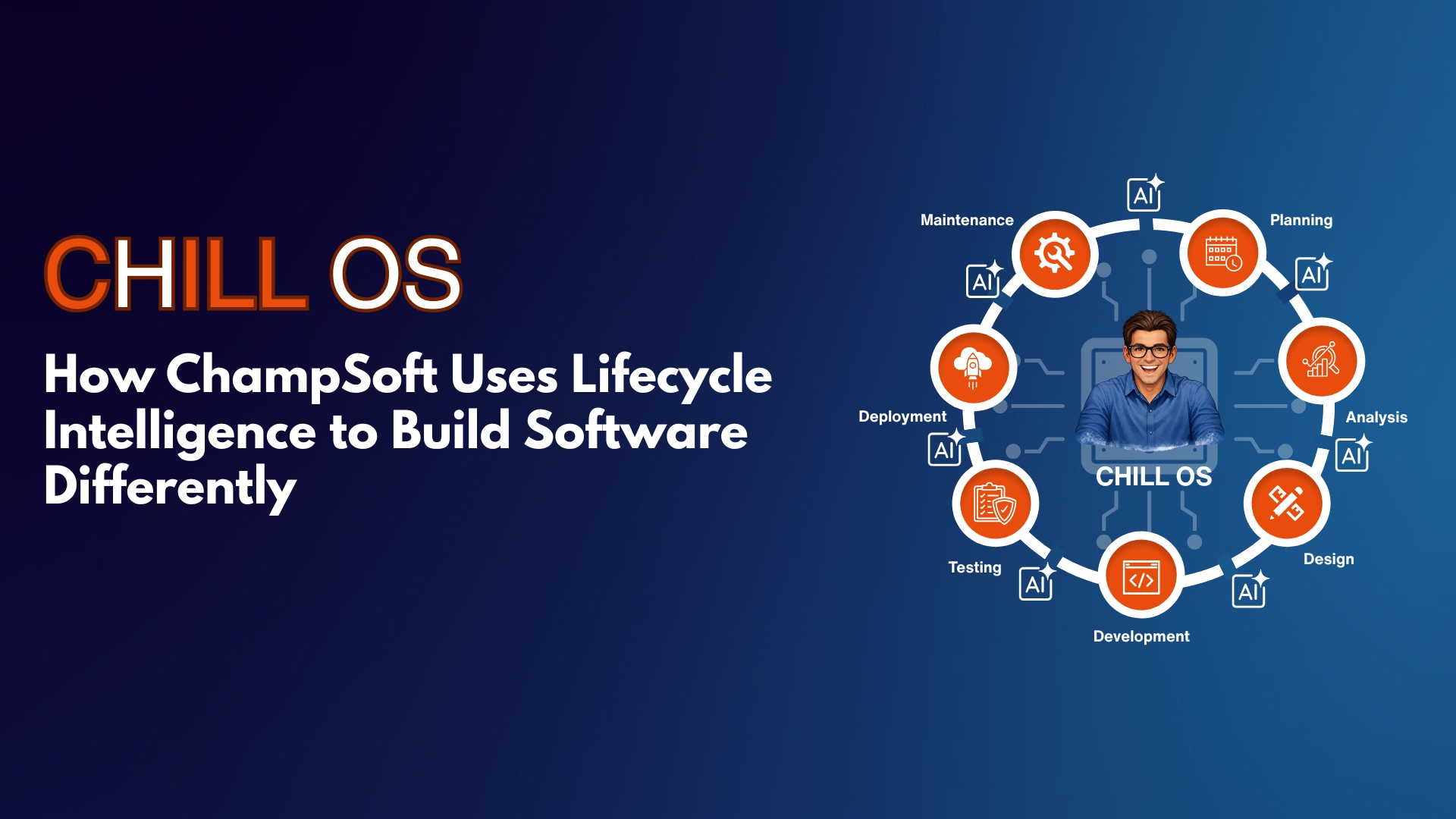
We built CHILL OS (ChampSoft Hybrid Intelligent Lifecycle Layer Operating System) an AI-native operating system that powers our Lifecycle Intelligence model by embedding intelligence, governance, and traceability into every stage of the software lifecycle. Rather than accelerating individual steps, Lifecycle Intelligence under CHILL OS redefines how software is conceived, created, and evolved as a single continuous system.
This article explains how ChampSoft Lifecycle Intelligence, powered by CHILL OS, works end to end with requirements through delivery and evolution and why this operating model changes how software is built.
What Is Lifecycle Intelligence in Software Development?
Lifecycle Intelligence is an AI-native operating model that embeds intelligence, governance, and traceability across the entire software lifecycle from requirements to delivery and ongoing evolution.
Instead of treating each phase as independent, Lifecycle Intelligence connects intent, design, development, testing, compliance, and delivery into a governed, continuously synchronized system.
The result is:
- No disconnection between business intent and technical output
- Continuous traceability from requirement to code
- Embedded compliance and governance
- AI-assisted critical thinking at every stage
This foundation reshapes how each lifecycle stage operates.
1. How Lifecycle Intelligence Transforms Requirements Management
In traditional projects, requirements are static documents that quickly drift out of sync with reality. In Lifecycle Intelligence, requirements are living, structured, and machine-interpretable from the start.
AI assists stakeholders in:
- Clarifying intent
- Identifying ambiguities and contradictions
- Mapping requirements to business goals, constraints, and compliance obligations
Critical-thinking agents challenge assumptions, surface risks early, and ensure requirements are complete, testable, and traceable.
From day one, every requirement becomes a first-class artifact that flows forward through the entire lifecycle. Nothing downstream is disconnected from intent.
This eliminates one of the most common sources of project failure: misalignment between what was requested and what was delivered.
2. How AI-Driven Design Systems Stay Aligned with Requirements
Once requirements are structured, Lifecycle Intelligence moves seamlessly into design system creation and evolution.
AI-assisted design agents help:
- Translate requirements into reusable design primitives
- Enforce consistency across components, patterns, and interactions
- Align design systems with accessibility, usability, and brand constraints
Because design systems are directly connected to requirements, changes in intent automatically surface design implications. This eliminates the traditional gap between “what was asked for” and “what was designed.”
Design is no longer a parallel activity. It becomes a governed, traceable extension of intent.
3. How UX/UI and High-Definition Mockups Stay Synchronized with Intent
With a governed design system in place, Lifecycle Intelligence supports UX and UI exploration through AI-assisted iteration.
Design agents generate and refine:
- User flows grounded in real requirements
- High-definition mockups that respect system constraints
- Interaction patterns that are consistent, accessible, and testable
Because mockups are derived from structured inputs, not static briefs, they remain synchronized with requirements and technical realities.
Stakeholders can review experiences earlier, with greater fidelity, and with full visibility into what each design decision supports. This dramatically reduces rework later in the lifecycle and improves alignment between experience and execution.
4. How AI-Embedded Project Management Improves Predictability
In ChampSoft Lifecycle Intelligence, project management is not a separate oversight layer—it is embedded intelligence.
AI-assisted planning agents:
- Continuously assess scope, dependencies, and risk
- Surface delivery implications of requirement or design changes
- Adapt plans dynamically while preserving governance
Instead of manual status tracking and reactive decision-making, project managers operate with real-time lifecycle awareness.
The result is predictability without rigidity plans to evolve intelligently while remaining controlled.
5. What Is Spec-Driven, AI-Native Development?
Lifecycle Intelligence shifts development from code-first execution to spec-driven implementation.
Specifications derived from requirements and designs become the authoritative source for development. AI-powered coding agents:
- Generate and modify code directly from approved specifications
- Enforce architectural, security, and compliance rules automatically
- Maintain traceability between specs, code, and outcomes
Compliance is not checked after the fact it is embedded in the agents themselves. Every line of code aligns with defined standards and policies.
Critical-thinking agents continuously evaluate implementation choices, flag risks, and validate assumptions augmenting human developers rather than replacing them.
Development becomes governed, traceable, and aligned by design.
6. How Continuous, Intelligent Quality Assurance Reduces Defects
In Lifecycle Intelligence, quality assurance is not continuously a late-stage gate.
AI-powered QA agents:
- Validate functionality against original requirements
- Test edge cases and failure modes early
- Ensure changes do not violate compliance or design constraints
Because QA agents share lifecycle context with development and design agents, they understand why the system behaves as it does not just whether it passes tests.
Quality becomes an ongoing property of the system rather than a final checkpoint. This reduces defects, regressions, and costly production incidents.
7. How Lifecycle Intelligence Supports Delivery and Long-Term Evolution
Delivery is not the end of the lifecycle; it is a transition.
Lifecycle Intelligence ensures that:
- Delivered software remains traceable to original intent
- Compliance posture is continuously maintained
- Future changes are evaluated within full system context
As requirements evolve, the same intelligence fabric guides updates across design, code, testing, and delivery without breaking governance or trust.
Software becomes a living, evolvable system instead of a sequence of disconnected releases.
Beyond Tools: Why Lifecycle Intelligence Is an Operating Model
ChampSoft Lifecycle Intelligence is not a collection of AI features or agents. It is an operating model where intelligence, governance, and execution are inseparable.
By embedding AI throughout the lifecycle:
- Decisions become explainable
- Outcomes become verifiable
- Teams move faster without losing control
This is how software is built at ChampSoft and how software development evolves when lifecycle intelligence replaces fragmented workflows.
Key Benefits of the Lifecycle Intelligence Operating Model
By embedding AI throughout the lifecycle, decisions become explainable and outcomes become verifiable. This operating model offers measurable advantages:
| Benefit | Strategic Impact | Enabling AI Agents |
|---|---|---|
| Lower Total Delivery Cost | Fewer manual handoffs and less rework; faster throughput from planning to release. | Planning, Spec-first Dev, CI/CD, & Release agents |
| Faster Time-to-Value | Tighter cycles and fewer bottlenecks mean features ship and iterate faster. | Dev, DevOps, CI/CD, & Release Manager agents |
| Higher Code Quality by Default | Consistent patterns and earlier detection of anti-patterns and edge cases. | Senior Dev, Architect, & Critical Thinking agents |
| Reduced Defects & Regressions | Automated test maintenance and improved defect triage lower production incidents. | Test Automation & QA agents |
| Stronger Security Posture | Continuous security checks and risk flagging occur during development, not after. | Security & Critical Thinking agents |
| Continuous Compliance | Governance guardrails run throughout delivery, ensuring audit-readiness in real time. | Compliance & Scope Guard agents |
| Better Scope Control | Requirements are normalized and changes validated to prevent “scope creep by email.” | Pre-sales, Scope Guard, & Meeting Sentiment agents |
| More Reliable Releases | Automated rollback awareness and pipeline health checks reduce downtime risk. | Release Manager, CI/CD, & Ops Monitor agents |
| Improved Decision Quality | Meetings turn into clear decisions with surfaced risks and captured next steps. | Meeting Sentiment & Critical Thinking agents |
| Real Single Source of Truth | Standardized artifacts and shared models eliminate tribal knowledge and conflict. | Data, BA, & Architect agents |
FAQs
What is Lifecycle Intelligence in software development?
Lifecycle Intelligence is an AI-native operating model that embeds intelligence, governance, and traceability across requirements, design, development, testing, and delivery.
How is Lifecycle Intelligence different from using AI coding tools?
AI coding tools assist isolated tasks. Lifecycle Intelligence connects AI across the entire lifecycle, ensuring traceability, compliance, and alignment from intent to delivery.
Does Lifecycle Intelligence replace human developers?
No. It augments human teams with AI-powered coding agents, QA agents, and critical-thinking agents to improve quality, governance, and speed.
How does Lifecycle Intelligence reduce project risk?
It reduces risk by embedding continuous compliance checks, automated validation, scope control, and real-time lifecycle awareness throughout delivery.