
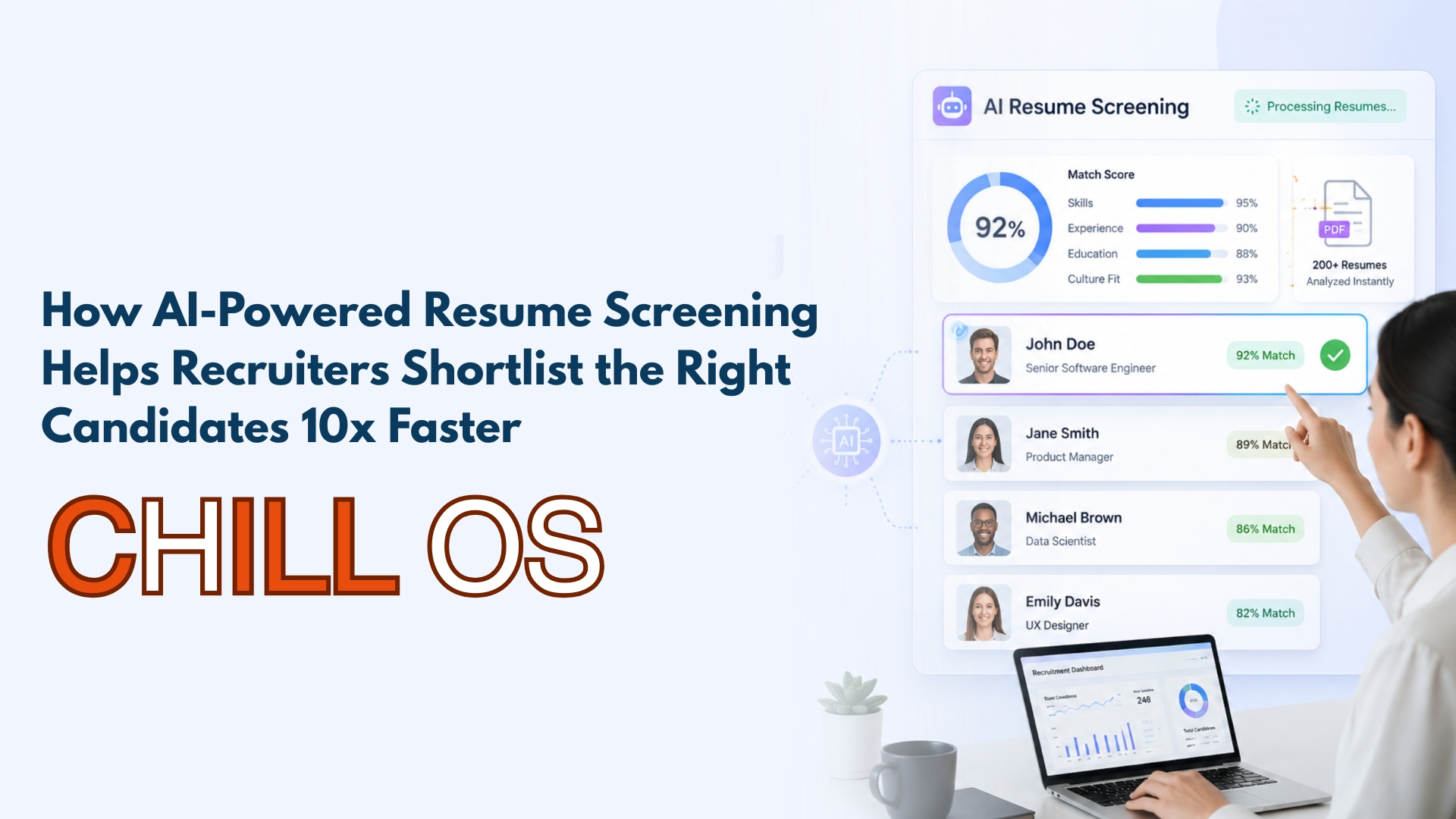





AI-powered resume screening uses machine learning and natural language processing (NLP) to automatically parse, score, and rank job applications against a job description, delivering a qualified shortlist in minutes instead of days. The primary difference between AI screening and manual screening is speed and volume: with AI, the same recruiter can evaluate 10x more candidates without burning out, without missing top talent buried in a pile of hundreds of applications.
Real data from Chill OS
The data visualizations below come directly from ChampSoft’s Chill OS platform, tracking a live hiring pipeline. They illustrate exactly where manual recruiting processes break down and where AI intervention delivers the fastest ROI.
Time in Stage — Chill OS Live Pipeline Data
Applied: 38 days | Screening: 35 days | Interview: 33 days
The screening stage alone consumes 48 days on average more time than either the application or interview stage. This is the single biggest bottleneck in the hiring funnel, and it is entirely addressable with AI-powered screening automation.
Hiring Funnel & Score Distribution — Chill OS Live Pipeline
Funnel: Applied 31 → Screening 15 → Shortlisted 7 → Interview 5 → Hired 1
Score Distribution: 2 candidates scored 0-9 | 1 candidate scored 50-59 | 17 candidates scored 70-79 | 17 candidates scored 80-89
Notice what the AI found: out of 31 applicants, 34 scored between 70 and 89 a strong, clearly differentiated shortlist that a manual reviewer would have taken days to surface. The AI delivered this distribution instantly, giving the recruiter a clear action: focus on the 80-89 cohort first.
What Is AI-Powered Resume Screening?
AI-powered resume screening is a recruitment technology that replaces manual resume reading with intelligent automation. Instead of a recruiter opening hundreds of applications one by one, an AI system parses each resume, extracts structured data skills, experience, education, role history and matches it against the specific requirements of a job description.
The result is a ranked shortlist of candidates, ordered by fit score, delivered in minutes. Unlike basic keyword filters built into traditional Applicant Tracking Systems (ATS), modern AI screening understands context. It recognizes that a candidate who ‘led a cross-functional engineering team through a 9-month product launch’ has project management experience even if those exact words never appear on their resume.
AI screening is not about replacing recruiters. It is about giving recruiters the right candidates to focus on instantly instead of spending 48 days in a screening backlog.
The technology behind these systems combines several AI disciplines:
- Natural Language Processing (NLP) — understands the meaning of resume text, not just exact keywords
- Machine learning — improves matching accuracy over time based on actual hiring outcomes
- Semantic analysis — identifies transferable skills and equivalent experience across different job titles
- Scoring algorithms — assign weighted fit scores based on required vs. preferred criteria
Why Manual Resume Screening Fails at Scale And What the Data Shows
Most mid-level job postings receive 300 to 500 applications within the first 72 hours. The Chill OS pipeline data above shows a real example: 31 applications entered the funnel, but only 1 moved into active screening, and 0 were formally shortlisted despite 34 candidates scoring between 70 and 89 on the AI scoring model. That gap between applicants received and candidates actioned is the manual screening problem made visible.
Problem 1: Screening becomes the longest stage
In the Chill OS Time in Stage data, screening consumed 48 days on average longer than the application stage (35.3 days) and the interview stage (33.9 days) combined. A process that should take hours stretches into weeks because each resume requires individual human attention. That is 48 days during which your best candidates are also interviewing elsewhere.
Problem 2: Fatigue degrades decision quality
Research consistently shows that decision quality deteriorates after extended repetitive tasks. A recruiter reviewing resume number 380 is not making the same quality judgment as when they reviewed resume number 12. Strong candidates buried in the second half of an application pile get overlooked not because they are unqualified, but because attention has already run out.
Problem 3: Inconsistent criteria across reviewers
When multiple recruiters evaluate the same candidate pool, alignment breaks down. One prioritizes certifications; another focuses on employer names, a third weights of years of experience. The shortlist that emerges reflects reviewer preference as much as job requirements introducing inconsistency and longer debate cycles among hiring teams.
Problem 4: Speed disadvantage costs top candidates
Strong candidates do not wait. They apply to multiple roles and accept the first reasonable offer. A 48-day screening delay as shown in the real Chill OS data is more than enough for high-quality applicants to move on. The pipeline data confirms this: 31 applicants entered, but 0 were hired.
Problem 5: Keyword matching misses qualified applicants
Traditional ATS filters operate on exact keyword matches. A candidate who uses ‘client relationship management’ instead of ‘CRM’ may be filtered out of a shortlist they belong on. The Chill OS score distribution shows what happens when semantic AI is applied instead: 34 out of 37 scored candidates registered above 70, giving recruiters a clear, high-quality cohort to work with immediately.
How AI Resume Screening Works in Chill OS — Step by Step
Chill OS approaches AI-powered screening as a workflow built around how recruiters work starting from job creation and ending with a scored, summarized shortlist. This is the process from beginning to end.
- Job creation with full requirements and JD — The recruiter creates a job posting inside Chill OS, including all role requirements, must-have skills, preferred qualifications, and a complete job description. This structured input becomes the benchmark the AI scores every candidate against.
- Resume upload — Resumes are uploaded directly into Chill OS. The platform supports unlimited resume uploads, so there is no cap on application volume. Resumes can be uploaded manually one by one or in bulk, giving teams flexibility in how they receive and process applications.
- AI profile screening — Each resume is analyzed by the Chill OS AI engine. The system parses structured data from every application of skills, experience, education, role history and runs semantic matching against the job requirements created in step one. This is not keyword filtering. The AI understands context and evaluates what a candidate has done, not just what words appear on their resume.
- Scored profiles with match summary — Every candidate receives an AI score (visible in the 0-99 score distribution) alongside a written summary of their profile and a breakdown of which skills from their resume match the job requirements and which are absent. The recruiter sees not just a number but the reasoning behind it makes the shortlist defensible and easy to calibrate.
- Recruiter action — With a ranked, scored, summarized list in hand, the recruiter focuses attention on the highest-scoring cohort first. In the example data, that means the 17 candidates in the 80-89 band receive immediate review reducing a 31-application pile to a focused shortlist of high-fit profiles.
Chill OS supports unlimited resume uploads with no per-application caps, making it suitable for both targeted hiring (10-50 applications) and high-volume recruitment drives (500+ applications) without changing the workflow or the cost structure.
Before vs. After: What Changes When AI Screening Replaces Manual Review
| Stage | Without AI (manual process) | With Chill OS AI |
| Applied stage | Recruiter reads every resume individually — 35+ days | AI parses all resumes instantly on upload |
| Screening stage | 48 days of manual review, comparison, and discussion | AI scores delivered in minutes with match summaries |
| Shortlisting | Informal, inconsistent — depends on reviewer attention | Ranked, scored, explainable shortlist ready for action |
| Interview stage | 33+ days to schedule — candidates already lost | Top-scored candidates contacted faster, pipeline moves |
| Offer stage | Often reaches 0 hires due to drop-off at screening | Higher shortlist quality reduces interview-to-offer gap |
Key Benefits of AI-Powered Candidate Shortlisting
Dramatically faster time-to-hire
The Chill OS data shows screening consuming 48 days in a manual process. With AI screening, that stage compresses to hours the time it takes to upload resumes and let the model score them. Companies using AI screening report an average of 85% time savings on their hiring process. A role that previously took 40 days to fill can be closed in 20.
Scored, summarized profiles — not just a ranked list
Chill OS does not simply rank candidates by a number. Each scored profile includes a written summary and a clear breakdown of which skills from the resume match the job requirements and which are missing. This gives recruiters the context to make a confident decision without reading the full resume before the initial screen.
Semantic understanding finds hidden talent
The score distribution from the live Chill OS pipeline illustrates this clearly: 34 candidates out of 37 scored above 70, a cluster of strong fits that keyword-based filtering would have missed if any used non-standard terminology. Semantic AI matching achieves significantly higher accuracy than keyword filters because it understands what a candidate has done, not just what words they used to describe it.
Unlimited scale without headcount growth
Chill OS supports unlimited resume uploads, which means a recruiting team of one can process the same volume as a team of ten without the 48-day backlog. As application volumes grow, the AI absorbs the volume increase without proportional recruiter time cost.
Consistent, criteria-based evaluation
Every resume in Chill OS is scored against the same job requirements, with the same weighting, every time. There is no variation between reviewers, no attention fatigue at resume 300, and no informal criteria drift between hiring managers. The shortlist reflects the job, not the reviewer’s last 20 minutes of focus.
Chill OS AI Talent Acquisition — Full Feature Overview
Chill OS is ChampSoft’s AI-powered operating platform for HR and business workflows. The talent acquisition module is designed for teams that need AI-powered screening without replacing their existing hiring judgment it augments the recruiter, not replaces them.
| Chill OS Feature | What it does for your team |
| Job creation with full JD | Create structured job postings with all requirements, must-haves, and preferred qualifications. The JD becomes the AI’s scoring benchmark for every applicant. |
| Unlimited resume uploads | Upload any number of resumes, individual or bulk. No per-application caps. Suitable for small, targeted searches and high-volume drives alike. |
| AI profile screening | Each resume is analyzed using NLP and semantic matching against the job requirements. The AI understands context, not just keywords. |
| Scored profiles (0-99) | Every candidate receives a numerical fit score based on how well their profile matches the job. Scores are distributed across a clear range, making prioritization straightforward. |
| Match summary per candidate | Each scored profile includes a written summary of the candidate and a skill-by-skill match breakdown showing which requirements are met and which are absent. |
| Hiring funnel tracking | Real-time visibility into how many candidates is at each stage: applied, screening, shortlisted, interview, offer, hired. Track time-in-stage to identify and fix bottlenecks. |
| Score distribution analytics | Visual breakdown of how candidates cluster across score bands immediately showing recruiters where the strongest cohort sits and how differentiated the pool is. |
Chill OS is built for organizations that need custom AI solutions — not generic SaaS platforms designed for average use cases. If your hiring process has specific role families, non-standard job titles, or niche skill requirements, Chill OS can be configured to match your exact screening logic. Contact the ChampSoft team at champsoft.com/chill-os to discuss your setup.
What to Look for in an AI Resume Screening Solution
The market for AI screening tools is large and varies significantly in quality, transparency, and fit for different hiring contexts. Here are the criteria that matter most when evaluating any solution, including Chill OS.
- Matching accuracy — does the system use semantic NLP and context-aware models, or does it fundamentally rely on keyword overlap? Ask for a live demo with a real resume that does not keyword-match the JD.
- Explainability — can recruiters see why a candidate ranked where they did? Chill OS provides a written match summary and skill breakdown per candidate, not just a number.
- Bias controls — does the platform provide structured, criteria-based scoring that reduces reliance on subjective impression? Are there human review checkpoints before any rejection?
- Customization per role — can you weight criteria differently for different role families? A sales role and an engineering role require different scoring models.
- Scale without cost increase — does pricing scale with volume? Chill OS supports unlimited resume uploads, so high-volume periods do not create unexpected costs.
FAQs
What is AI-powered resume screening?
AI-powered resume screening is a technology that uses machine learning and NLP to automatically evaluate, score, and rank job applications against a job description. Rather than a recruiter manually reading each resume, the AI parses candidate data, matches it semantically against role requirements, and delivers a ranked shortlist with written summaries explaining each score.
How does AI resume screening work in Chill OS?
In Chill OS, the recruiter first creates a job posting with full requirements and a job description. Resumes are then uploaded into the platform individually or in bulk, with no volume caps. The AI engine analyzes each resume, assigns a fit score from 0 to 99, and generates a match summary showing which skills and experience align with the role and which are missing. The recruiter receives a ranked, summarized shortlist ready for action.
How much faster is AI resume screening than manual review?
Based on real Chill OS pipeline data, the manual screening stage consumes an average of 48 days. With AI-powered screening, that stage compresses the time it takes to upload resumes typically hours, not weeks. Companies using AI screening report an average of 85% reduction in overall hiring process time.
How many resumes can be uploaded into Chill OS?
Chill OS supports unlimited resume uploads with no per-application caps. This makes the platform suitable for both small, targeted searches and large-volume hiring drives without changing the workflow, pricing structure, or screening quality.
What does the AI score and summary include?
Each candidate receives a numerical fit score from 0 to 99 based on how well their profile matches the job requirements. The score is accompanied by a written summary of the candidate’s background and a skill-by-skill match breakdown showing which requirements from the job description are covered by the resume and which are absent. This gives recruiters the context to make confident decisions without reading the full resume first.
Is AI resume screening biased?
AI screening tools can reflect bias if they are trained on historically biased hiring data. Chill OS addresses this through structured, criteria-based scoring tied to explicit job requirements, reducing reliance on subjective impression. Human review remains part of the workflow: the AI surfaces and ranks candidates, but hiring decisions require recruiter judgment. For organizations with specific compliance requirements, ChampSoft can configure additional bias-monitoring and anonymization settings at the implementation stage.
How is Chill OS different from off-the-shelf ATS platforms?
Off-the-shelf ATS platforms are built for average use across thousands of clients. Chill OS is a custom-configured AI platform built by ChampSoft around your specific hiring workflow, role families, and skill requirements. The scoring logic reflects how your organization evaluates candidates producing higher-quality shortlists and faster recruiter adoption than generic SaaS tools designed for the median hiring team.