






The first generation of telemedicine succeeded because it solved a basic logistical problem: connecting a patient to a clinician over a screen. Driven by urgent necessity, virtual healthcare adoption stabilized at levels roughly 38 times higher than pre-pandemic baselines. However, traditional video consultations inherently mirror the limitations of static, in-person clinic visits; they provide only a fleeting, point-in-time snapshot of a patient’s health status. In this context, AI-powered telemedicine: how virtual care is evolving beyond video consultations has become a defining theme in virtual healthcare and broader digital health solutions.
Today, the digital health landscape is undergoing a structural paradigm shift. By integrating artificial intelligence in telemedicine, machine learning ($ML$), and natural language processing ($NLP$) directly into the care continuum, virtual care is evolving from a reactive communication tool into an ambient, proactive, and continuously managed ecosystem. This evolution is reshaping clinical workflows, mitigating systemic biases, and improving diagnostic accuracy by up to 20% in complex specialties.
[Legacy Telehealth Pipeline]
Patient Symptom -> Scheduled Video Call -> Manual Charting -> Reactive Treatment
[Next-Gen AI Telehealth Pipeline]
Continuous Wearable Data -> ML Anomaly Detection -> Triage & Ambient Notes -> Proactive Intervention
The Rise of Telemedicine: From Video Calls to Infrastructure Integration
The transition from basic video conferencing to an intelligent clinical platform represents a shift from administrative convenience to clinical depth. Early virtual visits relied heavily on the patient’s subjective reporting and what a clinician could observe through a standard webcam. This model frequently left healthcare providers data-poor during critical decision-making moments.
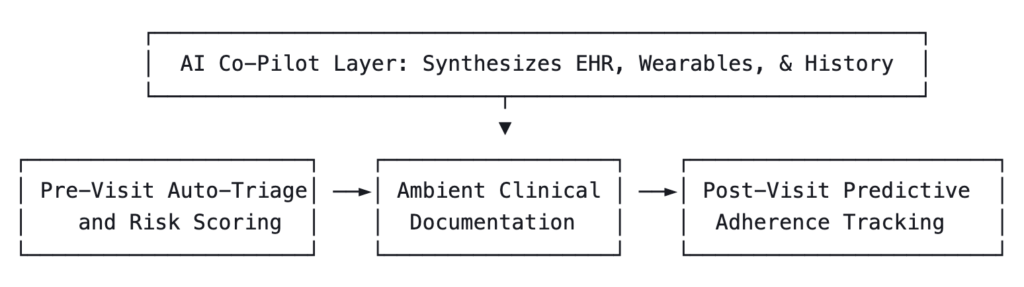
Modern, AI-integrated infrastructure solves this data asymmetry by synthesizing disparate streams of patient data before, during, and after the virtual consultation. Instead of replacing the physician, these advanced digital health solutions and platforms serve as an intelligent administrative and diagnostic co-pilot. They ingest information from electronic health records (EHRs), analyze historical patient baselines, and surface actionable insights at the point of care.

The business and clinical benefits of moving beyond legacy video calls include:
- Ambient Clinical Documentation: AI tools securely listen to patient-provider conversations in real time, translating natural speech into structured clinical notes (such as SOAP notes) and automatically syncing them with the EHR to eliminate hours of manual charting.
- Dynamic Pre-Visit Triage: Automated algorithms assess patient symptoms prior to the appointment, flagging high-risk individuals and matching them with the appropriate specialist or care level instantly.
- Continuous Long-Form Baselines: Rather than relying on a single, isolated blood pressure reading taken during a call, clinicians review longitudinal data trends captured naturally in the patient’s home environment.
- Closed-Loop Care Delivery: Intelligent systems follow up with patients automatically post-consultation, confirming prescription adherence, tracking recovery milestones, and escalating anomalies back to the clinical team.
Artificial Intelligence in Telemedicine: Core Technologies and Capabilities
To understand the scalability of next-generation telemedicine, it is necessary to examine artificial intelligence in telemedicine and the underlying algorithmic engines driving the technology. Rather than acting as a singular software package, practical artificial intelligence in telehealth (AI in telehealth) leverages a combination of four core computational disciplines:
1. Machine Learning (ML) & Deep Learning
At the foundation of predictive care are machine learning models capable of evaluating billions of data points to identify subtle correlations that elude human observation. For instance, deep learning architectures can cross-reference a patient’s current medication list, genetic markers, metabolic panels, and historic vital signs to predict adverse drug events or calculate precise risk scores for systemic failures like sepsis or cardiovascular events before clinical symptoms manifest.
2. Computer Vision
Computer vision has expanded the diagnostic boundaries of virtual consultations far beyond basic video quality. By using highly trained convolutional neural networks (CNNs), telehealth platforms can analyze high-resolution smartphone imagery or digital dermoscopic feeds submitted by patients. These algorithms assist remote dermatologists and radiologists by performing automated pixel-level analysis to flag suspicious lesions, diabetic retinopathy indicators, or wound healing trajectories with accuracy levels that rival board-certified specialists.
3. Natural Language Processing (NLP) & Large Language Models (LLMs)
Language technologies have progressed past rigid, text-based chatbots into empathetic, highly flexible conversational interfaces. Driven by clinically aligned LLMs, these tools understand complex medical vernacular, decipher inconsistent descriptions of pain or symptoms from patients, and translate dense medical jargon into culturally competent, multi-lingual patient instructions. This significantly reduces communication barriers across diverse global demographics.
4. Predictive Analytics & Edge Computing
Predictive analytics turns unprocessed data into a barrier for preventative health by executing optimised algorithms directly on consumer devices or safe cloud settings. Instead of waiting for a patient to experience an acute medical emergency, edge-computed algorithms constantly scan streaming biometric inputs, identify dangerous deviations from an individual’s personalized baseline, and alert care networks to intervene early effectively shifting healthcare from a system of crisis management to proactive preservation. This capability exemplifies AI in telemedicine at the point of care.
Beyond Video: AI-Driven Innovations in Virtual Healthcare
The integration of artificial intelligence is fundamentally changing how patients interface with virtual clinics. Moving beyond the flat interaction of a video grid, modern platforms weave themselves into the fabric of a patient’s daily environment. In AI-powered telemedicine, the goal is no longer just “seeing a doctor remotely”; it is the creation of a continuous loop of medical support that minimizes the friction of navigating health systems. This AI in telemedicine approach distributes tasks more intelligently across people and software.
This change alters the character of a medical consultation and divides responsibilities, as seen in the typical operating matrix below:
| Capability Layer | Legacy Video Telehealth | Next-Generation AI Telemedicine |
| Data Capture Continuum | Intermittent (Only during active call) | Continuous via passive wearable integration |
| Diagnostic Processing | Purely clinical observation & reporting | Machine learning anomaly detection & triage |
| Patient Engagement | Manual portal messages & text reminders | 24/7 NLP-driven conversational assistants |
| Clinical Efficiency | Manual typing, charting, and note-taking | Automated ambient clinical documentation |
By implementing this matrix, virtual care networks achieve a higher rate of preventative interventions. Patients diagnosed with complex or dynamic diseases are no longer left unmonitored between visits. Instead, automated systems process incoming metrics on a rolling basis, formatting summaries for the physician so that clinical time is spent solving problems rather than sorting through unorganized logs.
AI in Remote Patient Monitoring: Real-Time Data and Predictive Analytics
Remote Patient Monitoring (RPM) has evolved from an optional accessory into a pillar of modern chronic disease management. When managed by AI algorithms, RPM addresses the primary failure point of traditional home monitoring: data fatigue. A single cardiology clinic managing 1,000 heart failure patients can be flooded with tens of thousands of telemetry data points daily. Without an automated filter, critical trends get buried. In practice, AI in remote patient monitoring reduces noise while elevating actionable signals.
AI triage systems manage this data influx by executing several automated operations:
- Baseline Personalization: The algorithm calculates a unique mathematical norm for each patient’s vitals, completely ignoring static textbook ranges that may not accurately reflect a chronic patient’s baseline stability.
- Multivariable Cross-Filtering: Instead of triggering an alarm over an isolated spike in heart rate, the system cross-references the metric with respiratory rate, ambient temperature, and accelerometer movement data to confirm if the spike indicates clinical distress or basic physical exercise.
- Predictive Decomposition: The software detects gradual, downward micro-trends such as a 1% daily drop in blood oxygen over a week that would typically escape human notice until the patient reaches an acute state of decompensation.
The AI-Enabled Biometric Market: Transforming Digital Health Solutions
The commercial growth of the ai enabled biometric market serves as the physical foundation for these software breakthroughs. Consumer wearables and medical-grade home sensors have moved far beyond basic step-counting. They now leverage photoplethysmography ($PPG$), multi-spectral optical sensors, and micro-electromechanical systems ($MEMS$) to gather clinical-grade telemetry without invasive procedures.
The rapid scaling of this market is driven by innovations across several key sensor categories care.
These technologies give virtual clinics the ability to run automated health assessments asynchronously. For example, voice pattern analysis tools can scan a patient’s speech during a phone or video call, detecting the micro-acoustic shifts associated with early-stage vocal cord strain, cognitive decline, or respiratory fluid buildup. By changing how biometric signals are read, the market is transforming standard smartphones into highly accurate, passive diagnostic tools.
Personalized Medicine and Chronic Disease Management with AI
The true potential of AI-driven telemedicine is fully realized in its ability to deliver personalized medicine at scale. Traditional clinical guidelines are built around statistical averages derived from broad clinical trials. While useful, these averages often fail to account for the unique lifestyle, genetic variations, and multi-morbid realities of individual patients managing chronic conditions.
AI engines overcome this limitation by continuously adjusting treatment recommendations based on incoming data streams:
- Adaptive Glycemic Titration: For diabetes management, machine learning models analyze continuous glucose monitor ($CGM$) data alongside carbohydrate intake logs, predicting blood sugar dips hours before they occur and adjusting recommended insulin updates automatically.
- Dynamic Hypertension Protocol Management: Algorithms track blood pressure trends alongside sleep architecture and local weather data, helping clinicians safely modify drug dosages to counteract seasonal or stress-induced spikes.
- Asynchronous Therapeutic Optimization: Rather than forcing patients to wait for quarterly checkups, the platform flags safe opportunities to advance or adjust therapy plans based on continuous clinical improvement metrics.
AI-Powered Virtual Assistants and Chatbots: Enhancing Patient Engagement
A major bottleneck in modern healthcare is patient engagement outside the clinic walls. Traditional patient portals often feel cold, confusing, and completely transactional. AI-powered virtual assistants bridge this communication gap by acting as a 24/7 clinical touchpoint that responds with immediate, personalized information.
To achieve meaningful clinical utility, these assistants have evolved beyond rigid, button-based decision trees into highly sophisticated conversational agents: Clinical Operational Guardrails: Next-generation conversational AI tools must be strictly sandboxed. They do not diagnose conditions independently; instead, they reference verified medical knowledge bases to triage symptoms, explain medication interactions, and coordinate complex scheduling logic automatically.
When integrated into a care network, these virtual assistants reduce administrative strain by filtering out routine inquiries. When a patient asks about normal medication side effects, the assistant provides instant, clear guidance. If the inquiry describes high-risk symptoms, the conversational engine seamlessly escalates the chat, flags it for priority review, and connects the patient with a human nurse.
Improving Access and Equity in Virtual Healthcare with AI
The integration of artificial intelligence into virtual care systems provides a powerful mechanism for closing historical gaps in healthcare equity and access. Rural communities, low-income urban areas, and marginalized populations regularly face severe shortages of specialized medical personnel. AI scales clinical expertise, allowing single providers to safely manage larger patient panels without sacrificing care quality.
[Traditional System] Rural Patient ──► Traveling Hours ──► Urban Specialist (High Cost)
[AI Equity Pipeline] Rural Patient ──► Local Clinic + AI Triage ──► Remote Specialist (Optimized)
Furthermore, AI algorithms address language and cultural barriers that frequently cause medical misunderstandings. Advanced translation layers do more than translate words literally; they adapt idioms, account for regional health concepts, and frame instructions in culturally competent language. By optimizing resource allocation and lowering administrative overhead, AI-driven digital health solutions and platforms make virtual healthcare highly cost-effective, lowering barriers for uninsured and underserved groups globally.
Security, Privacy, and Ethical Considerations in AI-Powered Telehealth
Because AI-powered telemedicine depends on processing massive volumes of highly sensitive personal health information ($PHI$), safeguarding data integrity is an absolute prerequisite for public trust. Deep, multi-layered security architectures are necessary because distributed wearable networks and cloud-based algorithmic pipelines increase the attack surface.
Organizations deploying these systems must actively manage several key operational risk vectors:
- End-to-End Encryption Architecture: All biometric data streaming from consumer edge devices to cloud servers must be secured using robust cryptographic standards, ensuring data remains completely unreadable in transit and at rest.
- Regulatory Compliance Automation: Software infrastructure must feature built-in auditing mechanisms that ensure strict compliance with regional data protection frameworks, such as HIPAA in the United States or GDPR in Europe.
- Algorithmic Bias Mitigation: Training datasets must be intentionally curated to include diverse racial, socioeconomic, and geographic groups. This prevents machine learning models from projecting historical healthcare disparities onto automated diagnostic decisions.
- Transparent Consent Management: Patients must be given explicit, plain-language control over how their data is used, with clear options to opt out of automated profiling without losing access to basic care.
The Future of AI in Telemedicine: Trends, Challenges, and Opportunities
Looking ahead, the convergence of healthcare and artificial intelligence will continue to accelerate, driven by several emerging trends:
Ambient Clinical Intelligence
The future point of care will be entirely ambient. Microphones, optical sensors, and smart surfaces will document and analyze clinical encounters passively. This frees clinicians from their keyboards and allows them to focus entirely on human-to-human interaction.
Generative Treatment Simulations
Advanced digital twins virtual models of a patient’s unique physiology will allow doctors to simulate treatments, surgeries, or complex drug interactions in a virtual space before applying them to the actual patient.
Decentralized Virtual Networks
Super-specialized virtual clinics will scale globally, breaking down geographic borders and allowing top-tier medical specialists to consult on rare or complex cases anywhere in the world via AI-coordinated triage networks.
Conclusion: The Road Ahead for AI-Powered Virtual Care
AI-powered telemedicine has advanced far beyond the era of simple video calls. By converting raw data streams into actionable clinical insights, artificial intelligence gives healthcare providers the tools to deliver continuous, highly personalized, and equitable care.
As artificial intelligence in telemedicine continues to mature, success will require strong partnerships between technology developers, clinical leaders, and regulatory bodies. By balancing rapid technological innovation with absolute data security and ethical algorithmic design, the global healthcare system can transition into a proactive, accessible, and deeply compassionate ecosystem.
FAQs
How is AI-powered telemedicine different from traditional video-only visits?
It shifts virtual care from one-time video chats to continuous, data-driven, and personalized care. AI adds machine learning, natural language processing, and computer vision to improve diagnostic accuracy, enable predictive analytics, personalize treatment plans, integrate wearables for real-time monitoring, streamline workflows, and enhance engagement through chatbots and virtual assistants capabilities that matured rapidly during the COVID-19 pandemic, demonstrating artificial intelligence in telehealth at scale.
What role does AI play in remote patient monitoring (RPM), especially for chronic conditions?
AI in remote patient monitoring (RPM) enables continuous tracking via wearables and sensors, analyzes incoming data in real time, and uses predictive analytics to flag potential health issues before they escalate. This supports timely interventions, improves management of conditions like diabetes, reduces hospitalizations and emergency visits, lowers costs, and increases patient engagement through alerts and trend insights.
What is the AI-enabled biometric market, and why does it matter for telemedicine?
It encompasses non-invasive, AI-powered tools that assess biometric signals ranging from fingerprints, facial and voice patterns to health indicators like heart rate, oxygen levels, sleep, and stress. By extracting deeper insights and detecting anomalies early, these solutions strengthen remote diagnostics and monitoring, enhance security and privacy protections, empower patients with real-time metrics, and accelerate innovation across digital health.
How does AI improve access and equity in virtual healthcare?
AI-powered platforms and digital health solutions extend high-quality services to remote and underserved areas, optimize resource allocation to reach more patients efficiently, and break language barriers through multilingual interactions. Algorithms designed for cultural competence tailor recommendations to diverse backgrounds, while workflow efficiencies help reduce costs together narrowing disparities and making virtual care more inclusive.
What trends, challenges, and opportunities define the future of AI in telemedicine?
Key trends include deeper personalization, more sophisticated remote monitoring, tighter integration with wearables, expanded virtual healthcare networks, and improved mental health support. Major challenges are safeguarding privacy and security, complying with regulations like HIPAA, and obtaining high-quality, diverse datasets to reduce bias. Opportunities center on AI-enabled biometrics, specialized virtual clinics, and collaborations between tech firms and providers that can scale comprehensive, equitable virtual care.