





In 2026, how much mobile app development costs depends on the complexity, features, platform selection, and the mobile application development services you require. The price of creating a unique mobile application typically ranges from $35,000 to over $300,000, depending heavily on architecture, complexity, and feature density. A basic Minimum Viable Product (MVP) averages $25,000 to $50,000, a mid-tier custom business application costs $50,000 to $120,000, and an enterprise-grade app featuring real-time data sync, AI integrations, or complex backend systems costs $150,000 to $300,000+.
If you’re wondering how much app development costs, the extent of your project determines the response and the experience of the app development company or mobile app development firm you choose. Leading mobile application development services company providers like Champsoft deliver scalable application development services tailored to business goals.
Development costs are mathematically driven by total development hours multiplied by the engineering team’s hourly rate. To provide complete financial transparency, here’s an overview of how modern app development services and mobile software development services are typically structured worldwide:
| Application Complexity Tier | Core Feature Profile | Average Cost Range (USD) |
| Minimum Viable Product (MVP) | Single platform (mobile app development for iOS or Android), standard UI, basic email authentication, simple data inputs, no offline syncing. | $25,000 – $50,000 |
| Mid-Tier Custom App | Mobile app development for iOS and Android using Flutter/React Native, custom UI/UX, third-party API integrations (Stripe, Salesforce), basic dashboard. | $50,000 – $120,000 |
| Enterprise / Advanced App | Native or high-performance cross-platform, iOS and Android application development, real-time sync, generative AI/LLM features, custom microservices backend, strict compliance (GDPR/HIPAA). | $150,000 – $300,000+ |
The Core Drivers of App Cost
- Development Approach: Native development (separate Swift and Kotlin codebases) requires twice the engineering labor compared to a unified cross-platform approach using Flutter or React Native. At Champsoft, our custom mobile app development team specializes in cross-platform frameworks to reduce client code maintenance costs by up to 40%. As a trusted custom app development company, we provide scalable app development solutions for startups and enterprises alike.
- Backend Infrastructure: A simple standalone app is inexpensive. An app requiring a highly secure, scalable cloud backend (AWS or Azure), custom API development, and web-based administration portals rapidly increases technical scope. These mobile application development services are essential for enterprise-grade digital products.
- Compliance & Security: Applications that process payments, manage sensitive patient records, or maintain financial data require robust encryption, comprehensive security audits, and multi-factor authentication to ensure regulatory compliance and data protection. This is standard practice for experienced mobile app development service providers.
How much time does it usually take to build a mobile app?
The Timeline for Mobile Software Development Services: A custom mobile app project takes between 3 to 9+ months to move from initial discovery to App Store deployment. A lean MVP can be designed and launched within 3 to 4 months, medium-complexity business applications require 4 to 6 months, and large-scale enterprise platforms with intricate cloud infrastructures take 6 to 12+ months.
Whether you’re working with a mobile app development firm, an Android mobile app development company, or an app development company, timelines depend heavily on scope clarity and the speed of stakeholder feedback cycles.
Month 1: UX Design & Discovery → Months 2–4: Core Development Sprints → Month 5: QA & Beta Testing → Month 6: App Store Launch & Deployment.
To prevent project drift, software engineering projects are managed using Agile milestones. A typical 6-month development schedule functions as follows:
- Weeks 1–4 (Discovery & Prototyping): Define the technical architecture, develop user personas, and create interactive Figma wireframes to validate the user experience and product vision.
- Weeks 5–16 (Core Engineering): Develop the frontend interface, configure the database infrastructure, integrate third-party APIs and backend services, and conduct bi-weekly sprint reviews to track progress and ensure timely delivery.
- Weeks 17–20 (Quality Assurance & Hardening): Conduct comprehensive cross-device and cross-platform testing, perform automated security and performance assessments, and execute User Acceptance Testing (UAT) to validate functionality, stability, and readiness for launch.
- Weeks 21–24 (Deployment & Hypercare): Submitting apps to the Google Play Store and Apple App Store, overseeing approval cycles, and monitoring early performance telemetry.
The 7-Step Mobile Software Development Process
To build reliable software, teams must strictly adhere to a structured development life cycle. Skipping validation steps results in technical debt—costly code rewrites later down the line.
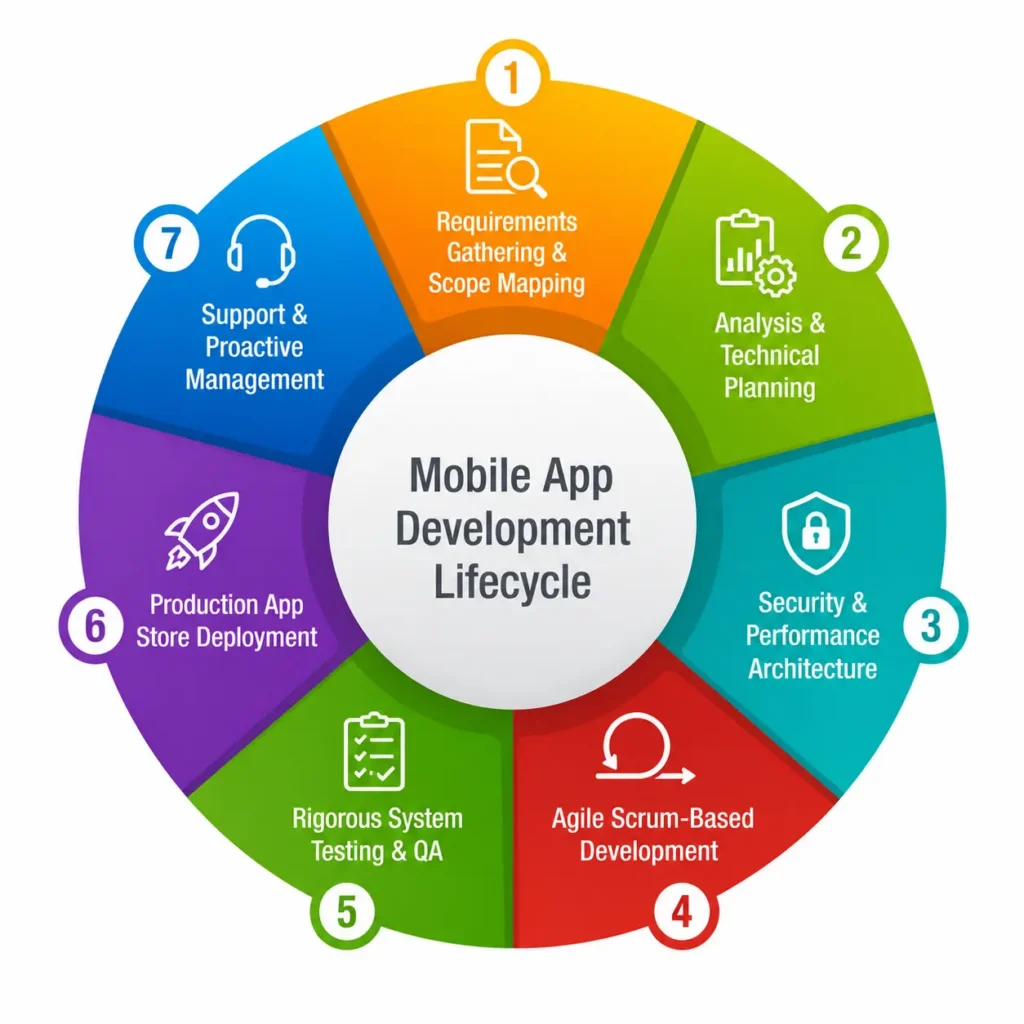
Our mobile application development services delivery framework divides production into seven interconnected engineering phases to guarantee zero-defect deployment.
1.Requirements Gathering & Scope Mapping:
We work closely with you to define your business objectives, understand target audience behaviors, and identify all essential compliance and regulatory requirements from the outset. The output is a clear Product Requirement Document (PRD) that serves as the blueprint for the entire build.
2.Analysis & Technical Planning:
Engineers evaluate the software ecosystem. We determine the optimal tech stack (e.g., Flutter for cross-platform speed vs. Native for deep hardware access) and plan data routing models for custom mobile software development projects.
3.Security & Performance Architecture:
Before writing user-facing code, we architect the core database schemas, API gateways, and token-based authentication mechanics. Security protocols are hardcoded into the structural foundations.
4.Agile Scrum-Based Development:
The project is split into 2-week development blocks called sprints. Code is written in modular environments and continually pushed to a staging environment, allowing stakeholders to test new features in real time. Our iOS and Android app development teams collaborate throughout every sprint.
5.Rigorous System Testing & QA:
Dedicated Quality Assurance testers run functional, regression, and performance tests across real Android and iOS devices. This ensures consistent performance across different operating systems and screen sizes, delivering high-quality Android and iOS application development services.
6.Production App Store Deployment:
We prepare and submit your application packages to Apple and Google. This includes configuring app store listings, provisioning privacy certificates, and optimizing store metadata for visibility.
7.Support & Proactive Management:
Post-launch, software requires continuous maintenance. We provide infrastructure monitoring, third-party API update handling, and prompt patches for new operating system releases as part of our ongoing application development services.
Why Enterprise Leaders Partner with Champsoft
Building an internal mobile development team requires months of hiring, expensive overhead, and operational friction. Outsourcing your project to an experienced mobile application development firm or custom app development company provides immediate advantages.
- Sovereign, Elite Talent Pools: ChampSoft deploys senior, dedicated software engineers, product owners, and QA analysts with deep domain expertise in cross-platform architectures, cloud services, and scalable web backend portals. Companies looking to hire mobile app developers can quickly scale with our experienced engineering teams.
- Direct Communication & Transparency: We eliminate the frustrating black box of typical outsourcing. You work directly with accessible, English-fluent engineers who integrate seamlessly into your internal communications workflows. As a trusted provider of top mobile app development services, we prioritize transparency throughout every engagement.
- IP Cleanliness & Security: You retain full ownership of all source code, design assets, and intellectual property from day one, safeguarded by comprehensive NDAs, secure development practices, and protected code repositories.
Whether you are seeking to automate internal operations via a custom enterprise app or launch a disruptive consumer platform, ChampSoft delivers custom mobile app development, mobile app development services in the USA, mobile software development services, Android apps development service, custom iOS app development services, and enterprise-grade app development solutions that turn complex technical requirements into smooth, high-conversion software products.
FAQs
What distinguishes cross-platform mobile development from native mobile development?
Native apps are built using platform-specific languages (Swift for iOS, Kotlin for Android), offering maximum performance and deep device hardware integration. Cross-platform apps use a single codebase (like Flutter or React Native) to run seamlessly on both platforms simultaneously, reducing development costs and timelines by up to 30–40% without sacrificing user experience. This makes mobile app development for iOS and Android an increasingly popular choice for businesses.
How do you protect the app’s data security and intellectual property?
At ChampSoft, we enforce strict data security standards from project kickoff. All client engagements are protected by comprehensive non-disclosure agreements (NDAs), and our developers follow secure coding practices (OWASP standards). Upon completion, 100% of the repository you receive the source code and intellectual property rights across all mobile application development services engagements.
Are there hidden ongoing costs after a mobile app is launched?
Post-launch costs generally include cloud infrastructure hosting (AWS/Azure), third-party API usage fees (such as SMS gateways or payment processors), and routine maintenance. We recommend budgeting roughly 15–20% of your initial development cost annually for ongoing software maintenance, security updates, and OS compatibility patches following your custom mobile app development project.