
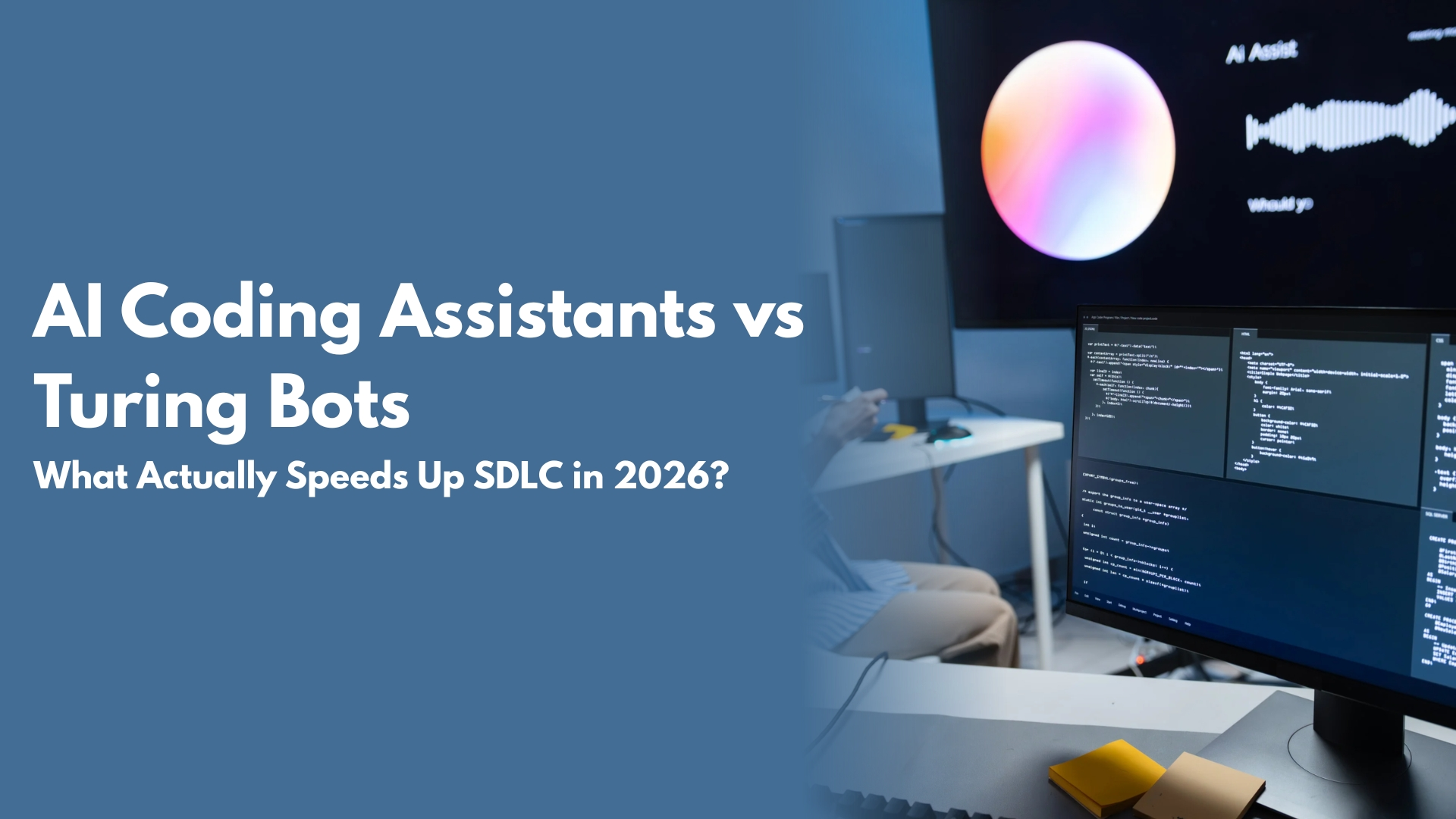





AI coding assistants (such as GitHub Copilot, Cursor, and Amazon CodeWhisperer) are ai coding tools that help individual developers write, review, and debug code faster at the Integrated Development Environment (IDE) level. Turing bots are autonomous AI agents that execute multi-step software tasks such as writing tests, raising pull requests, or updating documentation without human prompting at each step. In 2026, the biggest SDLC acceleration gains come from deploying both within a governed, spec-first AI-powered software development lifecycle (often called an AI SDLC or ai sdlc). Teams that embed AI coding assistants for developer productivity and Turing bots for workflow automation are shipping 30–55% faster while maintaining quality and compliance standards.
Introduction: Two Technologies, One Critical Question
Engineering leaders in 2026 are not asking whether to adopt AI software development. That debate is over. The question now is: which AI tools actually move the needle on your software development lifecycle (SDLC), and which ones create noise, technical debt, or security exposure without meaningful returns? This guide tackles the core question of AI Coding Assistants vs Turing Bots: What Actually Speeds Up SDLC in 2026? with data and implementation guidance.
Two categories of ai coding tools dominate the conversation: AI coding assistant tools that augment individual developers inside the IDE and Turing bots, autonomous agents that execute structured tasks across the development pipeline. Both promise speed. Both deliver results in different scenarios. And both carry risks if deployed without governance.
The rise of AI-driven software development has made this distinction more urgent than ever. Organizations investing in AI-powered software development need to understand exactly where each category of tooling creates value and where it creates risk before committing budget and engineering resources.
This guide gives engineering leaders the clearest, most honest breakdown of these two AI paradigms in 2026, grounded in how real delivery teams are using them, and how ChampSoft’s AI-augmented SDLC framework integrates both to maximize speed without sacrificing reliability, security, or auditability.
What Are AI Coding Assistants?
AI coding assistants are inline tools that integrate directly into a developer’s editor. These ai coding tools use large language models (LLMs) to predict, autocomplete, generate, explain, and review code in real time. They are the most widely adopted entry point into ai software development for most engineering teams.
The leading tools in 2026 include:
GitHub Copilot (now deeply integrated with GitHub Actions and PR reviews), Cursor (an AI-native IDE built on top of VS Code), Amazon CodeWhisperer (with enterprise-grade AWS and security scanning integrations), Tabnine (with on-premise deployment for compliance-heavy teams), and JetBrains AI Assistant (tightly coupled with IntelliJ-based IDEs).
What they actually do well:
AI coding assistants genuinely accelerate routine coding tasks. Studies conducted through 2025 and into 2026 consistently show that developers using ai coding assistants complete coding tasks 30–50% faster on average. They are especially effective at boilerplate generation, writing unit tests for isolated functions, translating pseudocode or specifications into working code, autocompleting repetitive patterns, and surfacing documentation inline during development.
Where they fall short:
AI coding assistants are reactive, not autonomous. They respond to a developer’s immediate prompt or cursor context. They do not understand the full software delivery lifecycle. They do not initiate actions, monitor pipelines, or coordinate cross-functional workflows. A developer still needs to review, validate, and integrate every suggestion. In regulated environments like healthcare, finance, legal, insurance every AI-generated output must be traceable and human-verified, which limits how aggressively teams can rely on them without governance scaffolding.
What Are Turing Bots?
Turing bots is the emerging term used in 2026 to describe autonomous AI agents capable of executing multi-step development tasks without requiring a human to prompt each action. They represent the next evolution of AI driven software development moving beyond in-editor assistance into full pipeline automation.
Unlike AI coding assistants that sit inside the IDE, Turing bots operate at the pipeline and workflow level. They connect to version control, CI/CD systems, ticketing tools, documentation platforms, and testing frameworks.
Examples of Turing bot behavior in production in 2026:
A Turing bot monitors a failing CI/CD pipeline, identifies the root cause, generates a patch, submits a pull request with a description, assigns the correct reviewer, and updates the Jira ticket all without a developer initiating each step. Another example: a Turing bot detects a dependency vulnerability, creates a remediation branch, runs the test suite, and flags a human reviewer only if tests fail.
Leading Turing bot frameworks and platforms in 2026:
Devin (Cognition AI) is the most-referenced autonomous coding agent, capable of executing entire feature development tickets. SWE-agent and open-source variants built on Claude or GPT-4-level models are being deployed in enterprise CI pipelines. GitHub Copilot Workspace is expanding toward agentic territory, allowing Copilot to plan and execute multi-file changes from a single task description. Custom agents built on LangChain, AutoGen, or CrewAI frameworks are being deployed by engineering teams to automate specific pipeline stages.
Where Turing bots actually add SDLC value:
Turing bots create the most impact in repetitive, well-defined tasks that cross system boundaries. Automated test generation and maintenance, dependency updates and vulnerability patching, documentation updates triggered by code changes, changelog and release notes generation, and code review comment triage are among the highest-return use cases documented in 2025–2026.
Where they introduce risk:
Turing bots generate the most risk when deployed without clear task scope boundaries, human review checkpoints, rollback protocols, and audit logging. Autonomous agents operating on production codebases without human oversight gates are a security and compliance liability particularly in HIPAA, SOC 2, and ISO 9001 environments where every change must be traceable to a human decision.
AI Coding Assistants vs Turing Bots: Head-to-Head Comparison
Primary purpose: AI coding assistants accelerate individual developer output at the task level. Turing bots automate multi-step workflows across the SDLC pipeline.
Where they operate: AI coding assistants work inside the IDE at the file and function level. Turing bots work across repositories, CI/CD systems, ticketing tools, and documentation platforms.
How they are triggered: AI coding assistants are triggered by developer action typing, prompting, or highlighting code. Turing bots are triggered by events such as a failing test, a new ticket, a merged PR, or a scheduled job.
Scope of action: AI coding assistants make suggestions and generate outputs for the developer to review. Turing bots execute tasks, create artifacts, and submit changes sometimes to production pipelines.
Human involvement: AI coding assistants require high human involvement, every suggestion is reviewed before use. Turing bots require medium involvement when properly configured, with human review gates at defined checkpoints.
Best SDLC phases: AI coding assistants excel during development and code review phases. Turing bots excel during testing, CI/CD, release, and documentation phases.
Risk profile: AI coding assistants carry low-to-medium risk incorrect suggestions are caught before commit. Turing bots carry medium-to-high risk without governance, especially if deployed on production branches without approval gates.
ROI profile: AI coding assistants show immediate ROI through individual developer velocity. Turing bots show compounding ROI over time as more pipeline stages are automated and maintained.
What the 2026 Data Says About SDLC Acceleration
The most credible data available in 2026 on AI driven software development acceleration points to the following patterns:
Teams using AI coding assistants alone report 20-35% reduction in time-to-feature-complete for isolated development tasks. The gains are most pronounced for mid-level developers working on well-scoped features.
Teams using Turing bots for automated testing, dependency management, and documentation report 15–25% reduction in release cycle time, independent of coding speed.
Teams combining both AI coding assistants for developer productivity and governed Turing bots for pipeline automation report compound SDLC acceleration of 35–55% compared to teams using neither, according to multiple engineering efficiency benchmarks published in Q1 2026.
Critically, teams that deployed technology without governance frameworks reported higher rates of security incidents, failed audits, and increased technical debt in the same period. Speed without structure does not translate to faster delivery in AI-powered software development; it translates to faster accumulation of problems.
The SDLC Phases Where Each Tool Wins
Requirements and Planning: Neither AI coding assistants nor Turing bots replace human-led requirement discovery. However, AI assistants can rapidly convert requirement documentation into initial technical specifications, user story drafts, and architecture notes. Turing bots can be configured to cross-reference new requirements against existing codebase patterns and flag conflicts automatically.
Architecture and Design: AI coding assistants are useful for rapid prototyping and evaluating alternative implementation patterns. Turing bots have limited value at this stage; architecture decisions require human judgment. This is true regardless of how mature an organization’s AI software development capabilities are.
Development: This is the primary domain of AI coding assistants. Developers using tools like GitHub Copilot or Cursor with well-structured prompts and codebase context see the highest productivity gains at this stage. Turing bots can assist by pre-generating scaffolding or boilerplate before a developer begins.
Testing: Both tools contribute here, but in different ways. AI coding assistants help developers write unit and integration tests faster. Turing bots can autonomously generate full test suites from specifications, run regression tests on PR submission, and maintain test coverage as the codebase evolves without developer initiation.
Code Review: AI coding assistants now offer inline PR review suggestions, catching common issues before human review. Turing bots can perform automated pre-review checks, security scanning, style enforcement, documentation completeness and triage which PRs need urgent human attention.
CI/CD and Deployment: This is the highest-ROI phase for Turing bots. Automated pipeline monitoring, failure diagnosis, rollback execution, environment configuration validation, and release gating can all be handled by governed Turing bot agents reducing deployment cycle time significantly. It is in this phase that AI-driven software development delivers its most measurable pipeline-level returns.
Documentation and Compliance: Turing bots generate the highest consistent value in documentation maintenance. Automatically updating API docs when endpoints change, generating audit logs for compliance, and maintaining changelog accuracy are tasks that previously consumed significant developer time and were often neglected.
The Governance Question: Why Most AI SDLC Deployments Underperform
The most common reason AI coding assistants and Turing bots fail to deliver promised SDLC acceleration is the absence of a governance layer.
Teams that deploy AI tools without a spec-first development process end up with AI generating code that drifts from architectural intent. Teams that deploy Turing bots without human review checkpoints end up with autonomous changes that bypass security controls. Teams that use AI software development tools without audit logging fail compliance reviews in regulated industries.
The pattern that consistently outperforms in 2026 is: AI-powered software development deployed within a structured, spec-first, human-governed software delivery framework where requirements are clear before any AI generates anything, where every AI output is reviewed by a qualified engineer, where all changes are traceable to a human decision, and where security and compliance checks are embedded in the workflow rather than bolted on at the end.
This is exactly the model ChampSoft’s AI-augmented SDLC and CHILL OS framework operationalizes. Rather than asking developers to figure out how to safely integrate AI tools on their own, ChampSoft embeds governed AI usage across every phase of the software lifecycle connecting requirements, development, testing, deployment, and compliance in a single auditable framework.
Who Should Use Which Tool and When
Early-stage startups with small engineering teams: Prioritize AI coding assistants first. They provide the fastest individual productivity gains with minimal infrastructure investment. Add governed Turing bot automation for testing and CI/CD once your pipeline is stable. This is the most accessible entry point into AI software development for resource-constrained teams using modern ai coding tools.
Mid-market companies scaling engineering teams: Both tools become relevant simultaneously. AI coding assistants improve onboarding speed for new developers and reduce context-switching overhead. Turing bots reduce release cycle time and prevent quality degradation as team size grows. A structured AI driven software development process becomes essential at this stage to avoid compounding inconsistencies across the team.
Enterprises in regulated industries (healthcare, finance, legal, insurance): Both tools must be deployed within a compliant governance framework from day one. AI-generated code must be traceable to human review decisions. Turing bot actions must be logged, auditable, and scoped to prevent unauthorized access to production systems. Off-the-shelf AI-powered software development tools without enterprise governance layers are not sufficient in these environments.
Engineering teams with legacy modernization mandates: AI coding assistants are valuable for generating modern equivalent code from legacy patterns. Turing bots can automate test suite generation against legacy systems before refactoring begins dramatically reducing the risk of regression.
Common Mistakes Engineering Teams Make in 2026
Treating AI coding assistants as a replacement for code review. AI suggestions are probabilistic, not correct. Every AI-generated line needs human review before merging.
Deploying Turing bots directly on main or production branches without approval gates. Autonomous agents should operate on feature or staging branches, with human review required before merging.
Measuring AI software development success by lines of code generated rather than by cycle time, defect rate, or deployment frequency. Volume of AI output is not a proxy for software quality or delivery speed.
Using AI tools without maintaining clear requirement documentation. AI performs dramatically better when working from structured specifications. Teams that skip requirement documentation and rely on AI to fill in intent end up with unmaintainable codebases.
Neglecting to audit AI-generated code for security vulnerabilities. LLM-generated code can and does contain injection vulnerabilities, insecure dependencies, and logic flaws. Automated security scanning of AI-generated code is not optional in any serious AI driven software development program.
How ChampSoft Integrates Both in a Governed SDLC
At ChampSoft, we do not recommend AI tools in isolation. Our AI-powered software development practice embeds both AI coding assistants and governed automation agents within our CHILL OS lifecycle framework a system designed specifically for enterprises that need speed and compliance simultaneously.
Our approach is spec-first: every AI-assisted development task begins with clear, human-authored requirements and architectural specifications. AI tools generate within those specifications, not instead of them.
Human oversight is mandatory at every critical lifecycle gate. AI-generated code is reviewed by qualified engineers. Automated agent actions are logged and auditable. No AI software development output reaches production without a documented human approval.
Security and compliance are built into the workflow from the first commit. Our delivery model aligns with HIPAA, SOC 2 Type II, and ISO 9001 standards meaning AI tools are deployed in ways that satisfy compliance requirements, not create new audit risks.
The result for our clients: faster delivery cycles, higher code quality, reduced defect rates, and clean compliance records delivered by a team that has been engineering production systems since 2010 and building AI driven software development capabilities since the technology matured enough to meet enterprise standards.
Conclusion: The Real Answer to What Speeds Up Your SDLC
In 2026, the engineering teams shipping the fastest are not the ones who picked the best AI tool. They are the ones who built the most disciplined framework for deploying AI within their delivery lifecycle.
AI coding assistants accelerate individual developer output. Turing bots accelerate pipelines and workflow execution. Neither one replaces architecture discipline, requirements, clarity, security rigor, or human judgment at critical decisions.
The organizations seeing 40-55% SDLC acceleration are those who treat AI as an amplifier of a well-engineered delivery process, not a shortcut around it.
If your engineering team is evaluating how to integrate AI coding assistants, autonomous agents, or a fully governed AI-augmented SDLC, ChampSoft can help you build it right. We have been delivering secure, scalable software systems since 2010 and have purpose-built our AI-augmented delivery framework for the compliance, quality, and auditability demands of enterprise environments.
Schedule a consultation with ChampSoft’s engineering team at ChampSoft.com to discuss how AI-augmented development can accelerate your roadmap without introducing risk.
FAQs
Where in the SDLC do AI coding assistants vs Turing bots deliver the most value?
AI coding assistants shine during development and code review by speeding up boilerplate, test writing for isolated functions, and inline PR suggestions. Turing bots excel in testing, CI/CD, release, and documentation by automating cross-system tasks like test generation and maintenance, dependency updates, pipeline monitoring and rollback, and auto-updating docs, changelogs, and audit logs.
What acceleration gains can teams realistically expect in 2026?
Teams using AI coding assistants alone see about 20–35% faster time-to-feature on well-scoped tasks. Turing bots focused on testing, dependencies, and docs cut release cycle time by roughly 15–25%. Teams that combine assistants for developer productivity with governed Turing bots for pipeline automation report 35–55% end-to-end SDLC acceleration compared to teams using neither.
What governance controls are non-negotiable for safe, compliant AI SDLC?
A spec-first process, human review gates, scoped autonomy, audit logging, and embedded security checks are essential. In practice: write clear specs before any AI output; require human approval before merges/deploys; run bots on feature/staging branches with rollback protocols; log every AI action and decision; and enforce security scanning and compliance checks (HIPAA, SOC 2, ISO 9001) throughout the workflow.
How should different organizations prioritize adoption?
Early-stage startups should start with AI coding assistants for quick individual gains, then add governed Turing bots for testing/CI once pipelines stabilize. Mid-market teams benefit from both at once—assistants for onboarding and daily dev speed, bots for cycle-time reduction and quality guardrails. Regulated enterprises must deploy both within a compliant, auditable governance framework from day one. Teams modernizing legacy systems should use assistants to translate patterns and bots to generate/maintain regression test suites pre-refactor.
How does ChampSoft integrate both tools while maintaining speed and compliance?
ChampSoft’s CHILL OS and AI-augmented SDLC embed a spec-first approach, mandatory human oversight at critical gates, auditable automation, and built-in security/compliance from the first commit. Assistants are used to accelerate developer tasks within clear specs; Turing bots automate governed pipeline work with logs and approvals. This yields faster cycles, higher quality, and clean audits aligned with HIPAA, SOC 2 Type II, and ISO 9001.