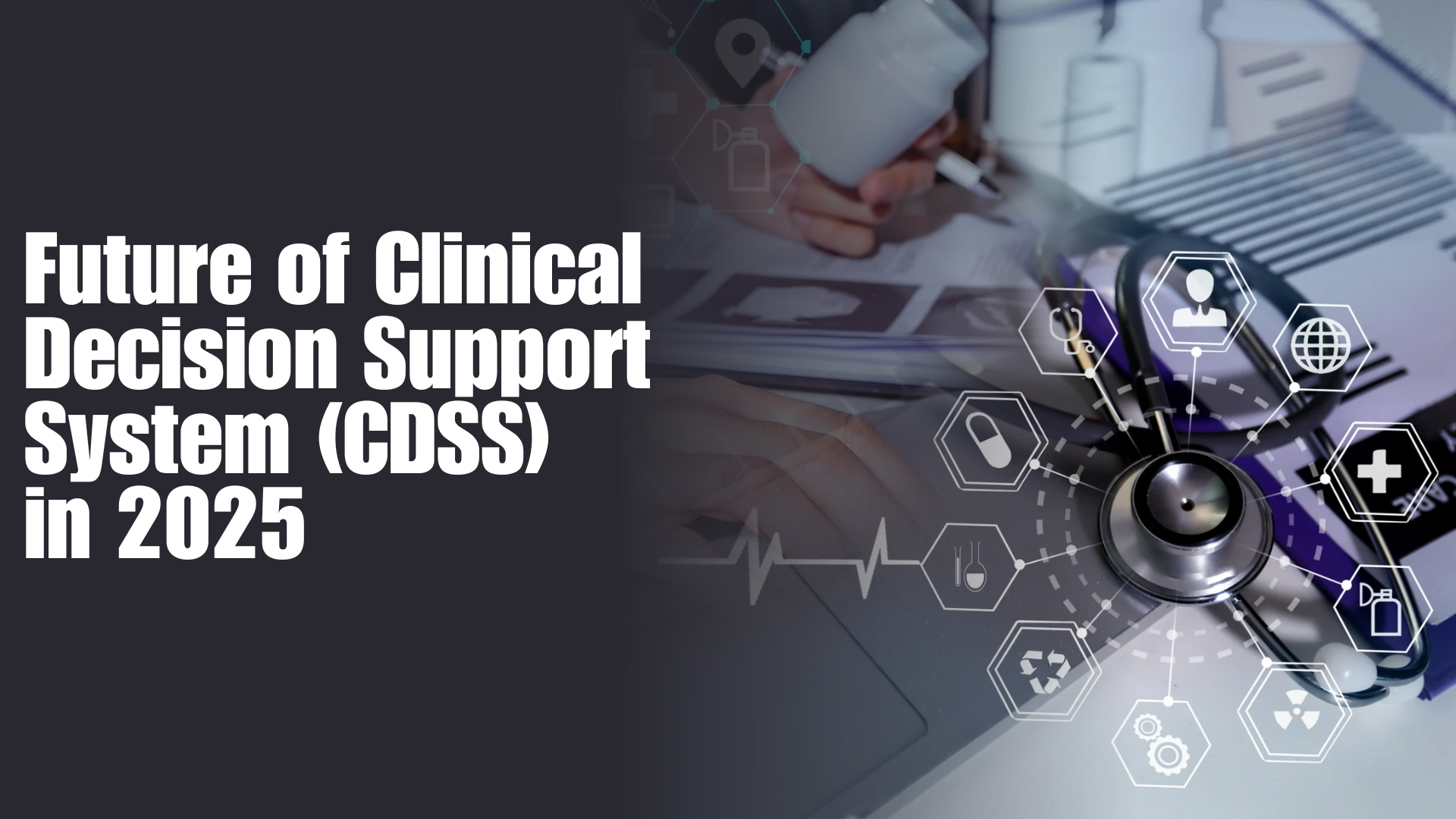
Clinical Decision Support System (CDSS) is rapidly becoming the backbone of modern healthcare decision-making as we enter 2025. Hospitals and health networks are under increasing pressure to reduce medical errors, optimize treatment plans, improve workflow efficiency, and comply with rising regulatory expectations. At the same time, AI in healthcare is accelerating progress in previously unimaginable ways. Clinicians now rely on healthcare decision support tools not just for reference, but as an intelligent partner in diagnosis, prediction, and personalized patient care.
The future of clinical decision support systems in 2025 represents a shift from rule-based alerts toward predictive, adaptive, and context-aware intelligence. This article explores how these changes affect physicians, patients, health systems, and the global digital health landscape while offering advanced insights that help healthcare organizations prepare for what’s next.
How Are Clinical Decision Support Systems Evolving in 2025?
CDSS used to work like static reference guides: physicians would input a condition or symptom, and the system would provide generalized guidelines. But technology has matured. In 2025, decision-making software has become proactive, real-time, and deeply integrated into electronic health records (EHRs), telemedicine platforms, and population health tools.
The transformation is driven by three advancements:
- Artificial Intelligence and Machine Learning: Systems now detect patterns unseen by human analysis, offering predictive recommendations and risk scoring.
- Natural Language Processing (NLP): CDSS can read, interpret, and summarize clinical notes automatically, reducing manual documentation.
- Cloud-Based Healthcare Platforms: Seamless data sharing improves collaboration between primary care providers, specialists, and diagnostic laboratories.
According to Markets, the CDSS market is expected to surpass $2.2 billion by 2025, fueled by AI healthcare technologies and high adoption in hospital systems.
This evolution means CDSS has shifted from an optional helper to a crucial piece of clinical infrastructure.
Why AI is Transforming Clinical Decision Support in Healthcare
AI is not replacing clinicians; it is enhancing their decision-making capabilities. In 2025, CDSS is increasingly AI-enabled, reducing diagnostic uncertainty by combining:
- Patient medical history
- Lab results and imaging
- Medication interactions
- Genetic data
- Lifestyle and socioeconomic factors
A powerful analogy:
If healthcare is a chess game, clinicians were once playing blindfolded. AI now turns the lights on, revealing not just the next best move but all possible outcomes.
Real-world example:
AI-based CDSS tools now help detect early signs of sepsis, a top cause of hospital mortality hours before visible symptoms appear. Reducing delays even by one hour can reduce sepsis deaths by up to 8%.
The result:
- Earlier interventions
- Fewer ICU admissions
- Higher patient survival rates
This demonstrates why healthcare organizations are prioritizing AI-driven decision support as a central pillar of digital transformation.
How CDSS Improves Clinical Decision Accuracy in 2025
In 2025, clinicians face both a flood of data and a shortage of time. Medical information doubles roughly every 73 days, making it impossible for any one professional to keep up. CDSS bridges this gap.
It strengthens clinical accuracy through:
- Diagnostic precision: Suggesting differential diagnoses matched to symptoms and lab patterns
- Medication safety: Flagging harmful drug interactions and allergies in milliseconds
- Evidence-based guidance: Presenting updated treatment pathways and trial outcomes
- Follow-up consistency: Ensuring no steps are missed during patient monitoring
A Harvard Medical School survey found that up to 30% of diagnostic errors in primary care are preventable with advanced decision-support systems.
CDSS ensures clinicians aren’t overwhelmed by data; it translates data into actionable insight.
Predictive Analytics in CDSS: The Future of Proactive Care
Predictive analytics is the technology that takes CDSS beyond the hospital walls. Instead of responding only when a condition worsens, CDSS can now predict risks before symptoms escalate.
Key predictive use cases in 2025:
- Identifying individuals at high risk of diabetes, stroke, COPD, and cancer
- Recommending preventive therapies and behavior modification
- Using genomics to forecast drug response (pharmacogenomics)
- Predicting emergency room readmission risks
Healthcare moves from reactive → preventive → precision driven.
This shift greatly reduces long-term care costs and improves quality of life.
Clinical Workflows in 2025: Seamless Human + AI Collaboration
Doctors often experience alert fatigue, too many notifications, and not enough relevant insights. In past systems, CDSS often interrupted rather than assisted workflow.
2025 addresses this with workflow-aware automation:
- Alerts dynamically adjust based on clinician activity
- AI prioritizes only high-value or urgent notifications
- Repetitive tasks like note taking or coding are auto generated
- Systems integrate with telehealth, reducing friction in remote care
Human creativity and empathy remain irreplaceable.
AI handles the administrative and analytical burden, freeing clinicians to do what matters most: treat patients.
How CDSS Improves Patient Safety and Reduces Medical Errors
Medical error is still a global crisis classified as the third leading cause of death in some countries. CDSS directly targets this problem.
Safety improvements in 2025 include:
- Automated adverse drug reaction checks
- Real-time vitals monitoring to detect dangerous trends
- Surgical decision support reducing procedural risks
- Remote patient monitoring enabling earlier intervention
Hospitals report up to 40% reduction in medication-related errors after implementing advanced decision-making software.
The larger impact:
A safer, more transparent healthcare system where trust between patients and providers strengthens.
Interoperability in Healthcare Decision Support (Universal Data Access)
A CDSS is only as smart as the data it can access. Historically, data was locked in different systems and formats.
In 2025, interoperability takes center stage with:
- FHIR standards enabling cross-platform communication
- Cloud-based health information exchange
- APIs for third-party integration
This creates a continuous data ecosystem:
Primary care → Specialists → Labs → Imaging → Home monitoring → Pharmacy
All connected, contextual, and available instantly.
It marks the end of siloed patient records and the beginning of holistic patient insight.
Data Security, Trust, and Ethical AI in CDSS
Patients are more aware of data privacy, raising crucial questions:
Who owns the data?
How is AI trained?
Can bias affect care decisions?
In response, healthcare systems in 2025 follow:
- Transparent AI recommendations physicians can validate
- Role-based access control to sensitive information
- Stronger encryption and cybersecurity protocols
- Ethical governance frameworks
Machine intelligence must be accountable.
Human clinicians always have the final decision-making authority.
What Are the Challenges Still Limiting CDSS Adoption?
Despite progress, barriers remain:
- High budget requirements for smaller facilities
- Training and cultural resistance among clinicians
- System integration complexity with legacy EHRs
- Concerns over workflow disruption
Organizations that succeed typically adopt phased implementation with:
- Pilot testing
- Continuous feedback loops
- Measurable ROI targets
Success depends not only on technology but on people embracing change.
The Future Benefits of CDSS for Hospitals and Health Networks
Healthcare is becoming data-driven, preventive, and personalized. With CDSS fueling this transition, hospitals can expect:
| Category | Impact |
| Clinical Outcomes | Better diagnosis, fewer complications |
| Cost Efficiency | Reduced readmissions and waste |
| Patient Experience | Faster care, improved communication |
| Workforce Productivity | Less burnout, automation of routine tasks |
| Regulatory Compliance | Documentation that supports audits and reporting |
The future of healthcare decision support is not assistance, it’s partnership.
Choosing the Right CDSS Vendor in 2025: What to Look For
Healthcare organizations should partner with technology providers who understand:
- AI-driven clinical workflows
- Scalable healthcare infrastructure
- Integration with existing hospital systems
- Local compliance requirements
- Specialty-specific decision support
A strong partner ensures a smooth transition with minimal downtime.
If your healthcare organization is based in the United States, particularly in Tennessee, a healthcare software solution provider in Nashville can provide localized support and regulatory expertise tailored to your region.
Conclusion
Clinical decision support systems in 2025 are reshaping healthcare into a smarter, safer, and more connected ecosystem. By combining AI, predictive analytics, EHR integration, and ethical governance, CDSS delivers real-time intelligence that improves decision-making across every stage of care.
The next wave will go even further:
- More personalization with genomic insights
- Wider adoption in telehealth and home care
- AI-driven automation that reduces burnout
- Scalable, globally connected digital health infrastructure
Healthcare is evolving, and CDSS is the bridge to a future where clinicians make decisions with confidence and patients receive care tailored uniquely to them.
FAQs
What is the future of clinical decision support systems in 2025?
CDSS will become AI-driven, predictive, cloud-integrated, and more patient-centric, offering smarter recommendations and improving diagnostic accuracy.
How does AI improve CDSS in healthcare?
AI enhances CDSS through machine learning predictions, automated data interpretation, and real-time risk detection supporting better clinical choices.
What are the main benefits of CDSS for hospitals?
It reduces medical errors, lowers costs, increases workflow efficiency, improves patient outcomes, and supports consistent evidence-based care.
Is CDSS replacing doctors?
No. CDSS supports clinicians by analyzing data and automating tasks, but human judgment remains essential for patient care.